
Bixby Family History — England
Ancient Victor Bixby Family History
The goal of this notebook is to reach back into history and trace the Bixby family tree with bits and pieces of geography and history to provide some insight into the context of this family. Following their lives may provide an appreciation of the foundation upon which we stand. That said, the bits of history provided are obviously over-simplified to be able to make this task achievable. Likewise, the family members discussed are points along the tree. The actual complete genealogy is provided online at Ancestry.com.
We are blessed the early generations of this family line has been previously well researched and documented. I have broken the story into sections:
England, Western Suffolk County: 1360-1640
Care was taken to use resources as close to primary as possible and not repeat/copy other's errors (there are many out there) however, no guarantees can be made.
I hope you enjoy the story as much as I did researching it and trying to capture it.
For the 'Younger Generation' - you are probably asking right up front --- how am I related to these people. On the next page I am including the 'end of the story' up front. I picked Victor Bixby here to have a central point for my cousins to be able to include their children, grand-children and great grandchildren into the story. As you can see, we've gotten too large to be able to include the generations below mine (grand-daughter of Victor Bixby) on one page of chart. I pass the torch on to the next generation to continue the story.
Bonny (Wilcox) Collins
Bonny.collins@bresnan.net 970.623.3243
March 2016
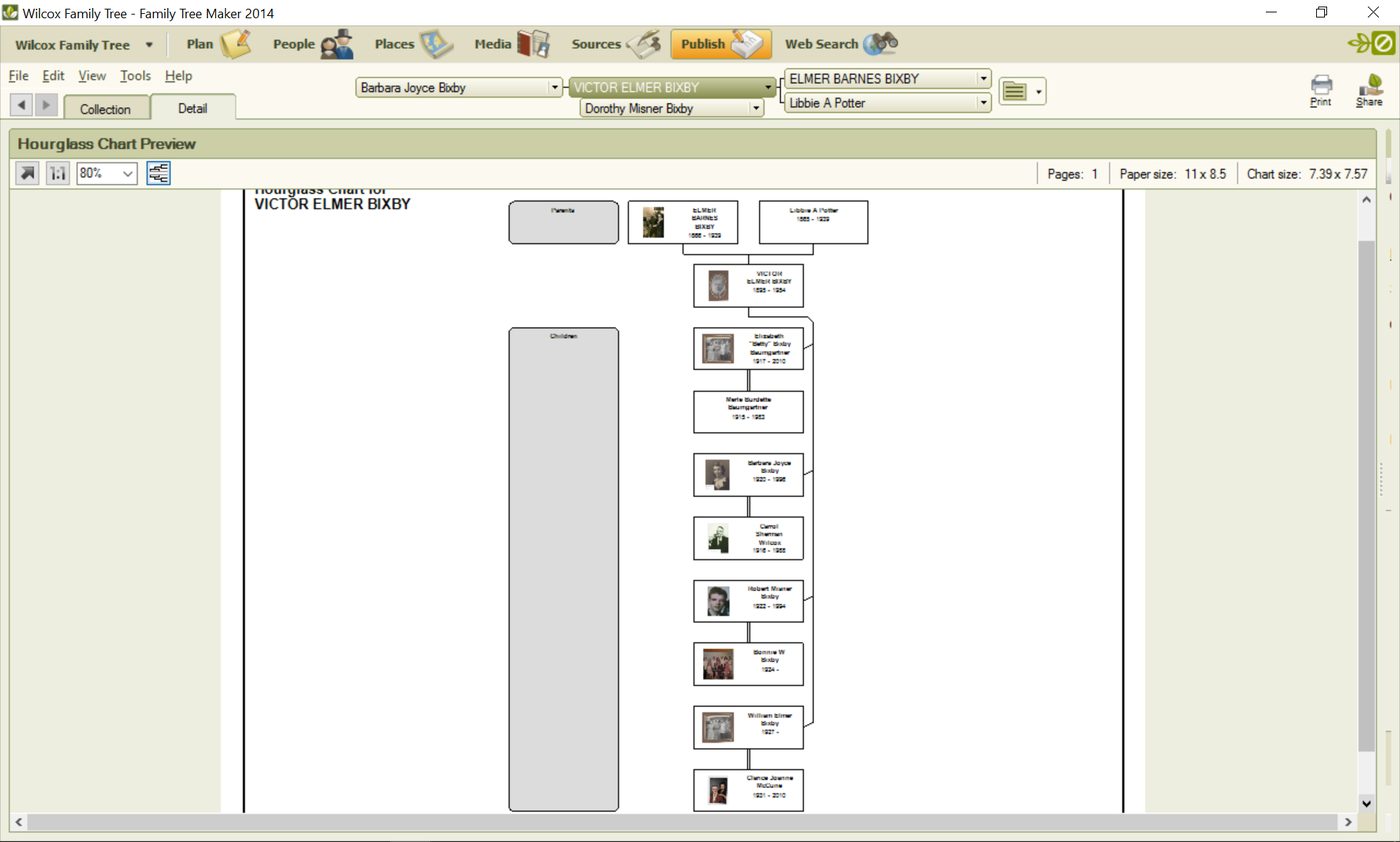
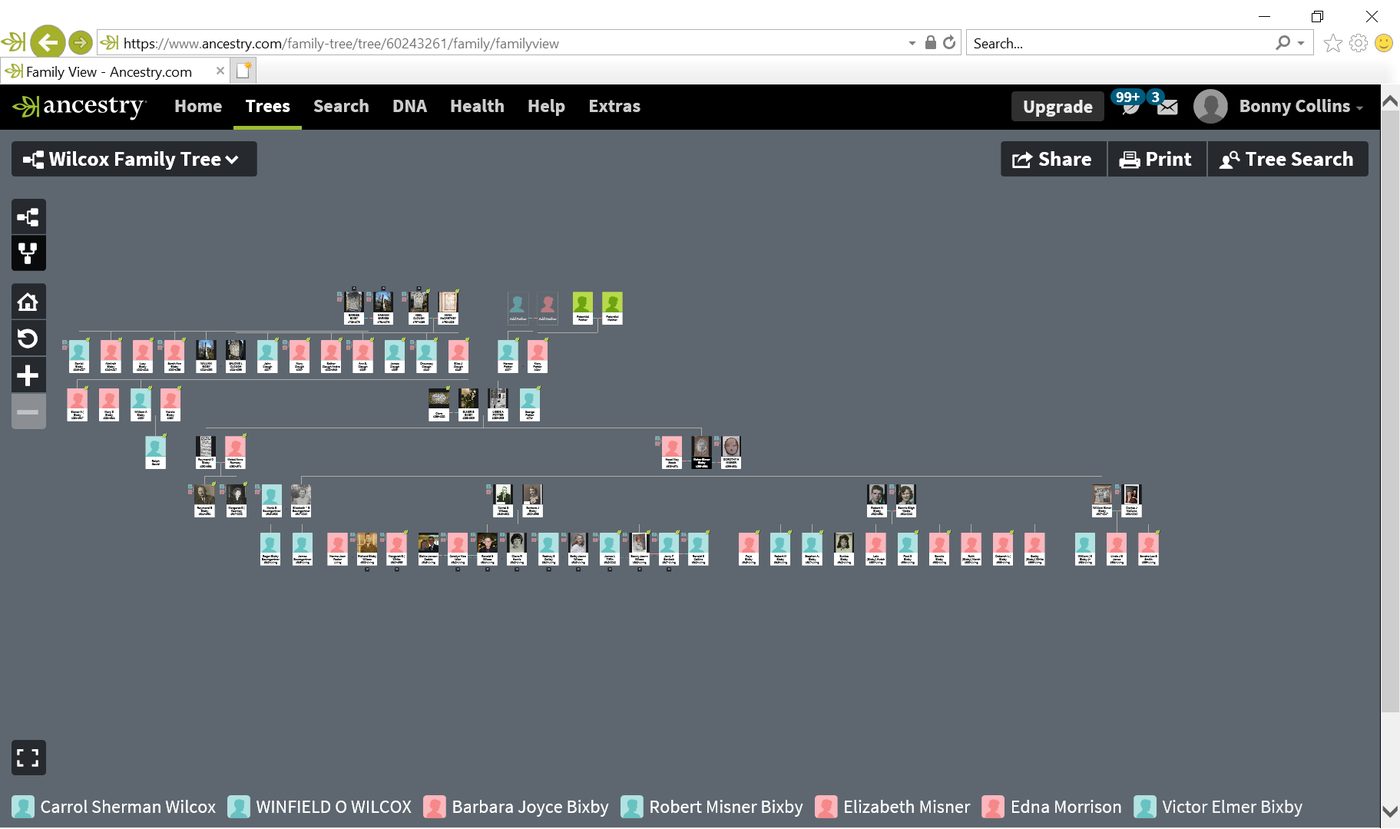
Editorial note: the screen capture below is from Ancestry.com, http://trees.ancestry.com/tree/60243261/family?cfpid=32054784845 unfortunately it does not provide a lot of options for printing. To make it fit better; ideally I would have excluded spouses of the lowest generation and shown only the cousins. Some birth dates of cousins may be estimates. I would love corrections.
The Bixby family is first documented in Western Suffolk County England in the mid 1300's and our line of the family stays within a 10 mile radius for the following 275 years. To put the family story into context, below is a brief summary of English history. I didn't enjoy history in school and consequently had no background. I've included what I thought was relevant and interesting. If it is too simplistic, sorry. If it pricks your curiosity to dig deeper and wider, great.
Before the Beginning — the Bekesbys of Suffolk
BEFORE THE BEGINNING:
The Middle Ages occurred between 476 (fall of the Roman Empire) to 1453 (Fall of Constantinople). The Feudal system was in place with King, Barons, Knights and Serfs. England was under the authority of the Catholic Church and organized into parishes. The church and the 'ruling class' (King and nobles) had a dynamic tension for power. In many cases the church had more wealth and control over society and culture. It was essentially the local government dealing with local disputes such as stealing, breach of promise, etc. The church taught about heaven and hell. It taught the way to avoid hell was to participate in the sacraments of the church (baptism, communion, marriage, etc.) and then controlled who was allowed to participate. The message clear, if you didn't do what the church said, you were going to hell. Ecclesiastic records were hand written in Latin. Few could read or write. The church was the 'voice' to direct citizens.
Crusades 1095-1204 : England participated by sending troops into Europe and the Middle East. Most troops were "private" armies of Lords and the men he could enlist to serve. This was the age of chivalry, knights and bloody battles.
Magna Carta 1215 (signed in Bury St. Edmunds in Western Suffolk County): It was originally a peace treaty between the King and rebel Barons which forced the King to acknowledge Barons' rights and which initially neither side lived up to. During the middle ages, it had little effect on untitled individuals in England. It was revised and reissued multiple times into the 19th Century. It became an icon of the principle of individual rights over a divine right of kings and habeas corpus (detainees can seek relief from unlawful imprisonment). It was influential in establishing the American Constitution in 1787.
The Black Death (Bubonic Plague) : From 1348-49, the plague raged in England. It is estimated to have killed between 25% - 60% of the population of England. It had begun in 1330's in China; from 1347-1352 it killed at least 1/3rd of Europe's population; 25,000,000 died. Even after the worst was over, smaller outbreaks continued for centuries. It did not die out until the 1600's.
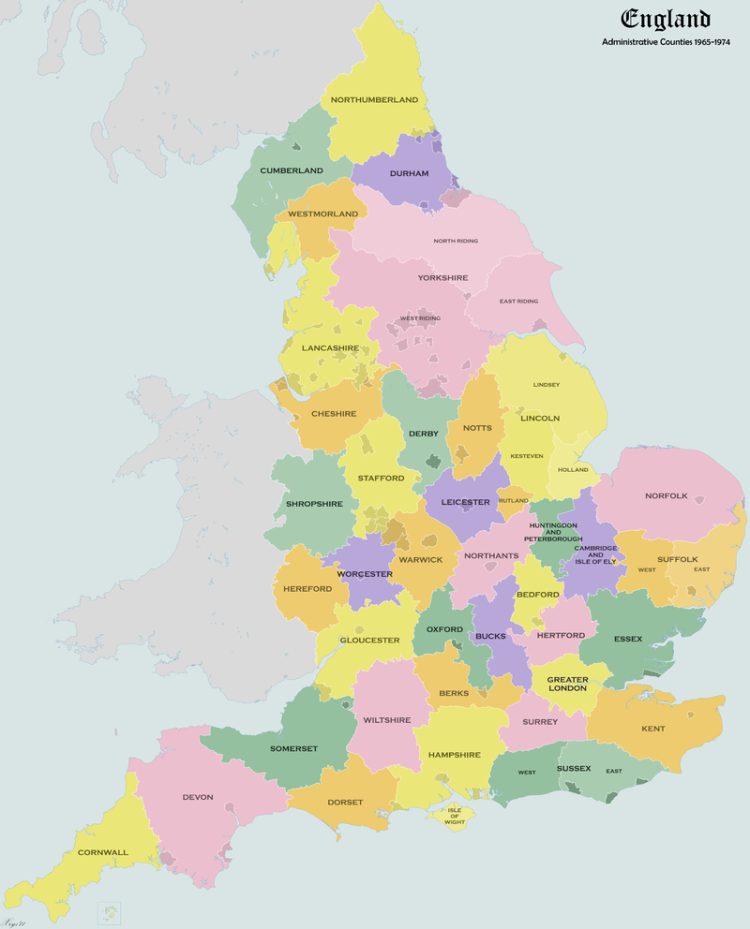
The recorded Bixby story begins near the end of the Middle-Ages when John Bekesby was born about 1365 in Felsham parish, western Suffolk2 county, England.
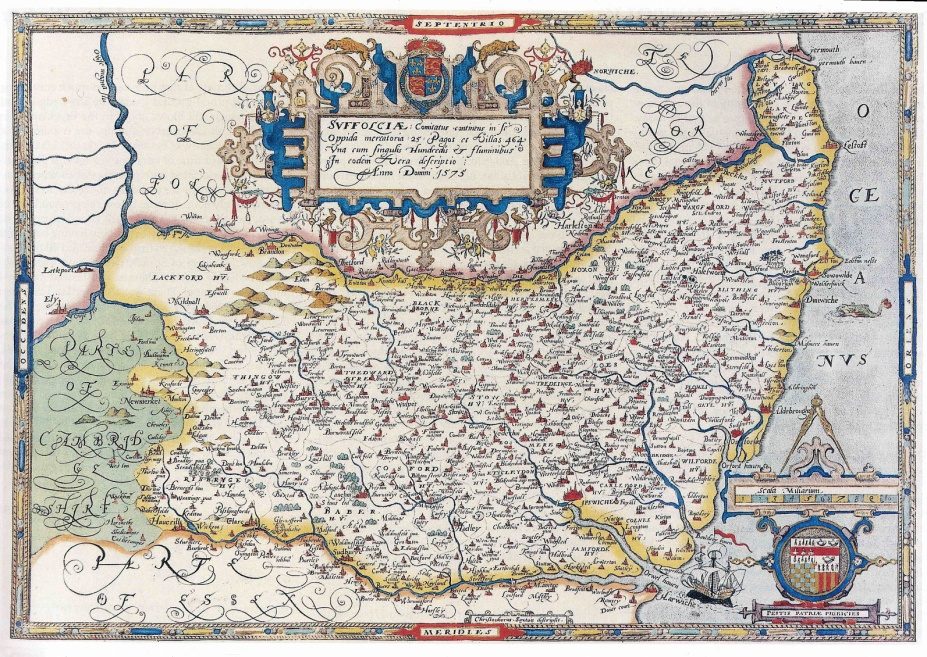
In the year 1086, Felsham parish had "39 households with enough oxen to cultivate up to 1,000 acres" . In 2005, its population was 420. It was and is a small agricultural area including sheep for wool. History records while serfs and the feudal system still operated in some counties, Suffolk County had a higher number of smaller manors and free hired workers than many other counties.
In 1427 there are records of Walter Bekesby buying land in Thorpe Morieux (3 miles from Felsham). In June 1459, the will of Walter Bekesby of Thorpe Morieux, Suffolk, was filed in Bury St. Edmunds. It provided for the division of his lands and goods between his wife, sons, daughter and churches in Felsham and Thorp Morieux. He was a free landowner; not titled nor a serf. The eldest son, Robert, was bequeathed property and care of the widow, Margary. To second son, Nicholas, age 44 (b. 1415), "I bequeath to Nicholas my son ten marks cash". Nicholas, is the ancestor we will continue to follow and leave all other branches of the tree to flourish and provide relatives in nearby locations. Nicholas and the following four generations stayed in Thorpe Morieux.
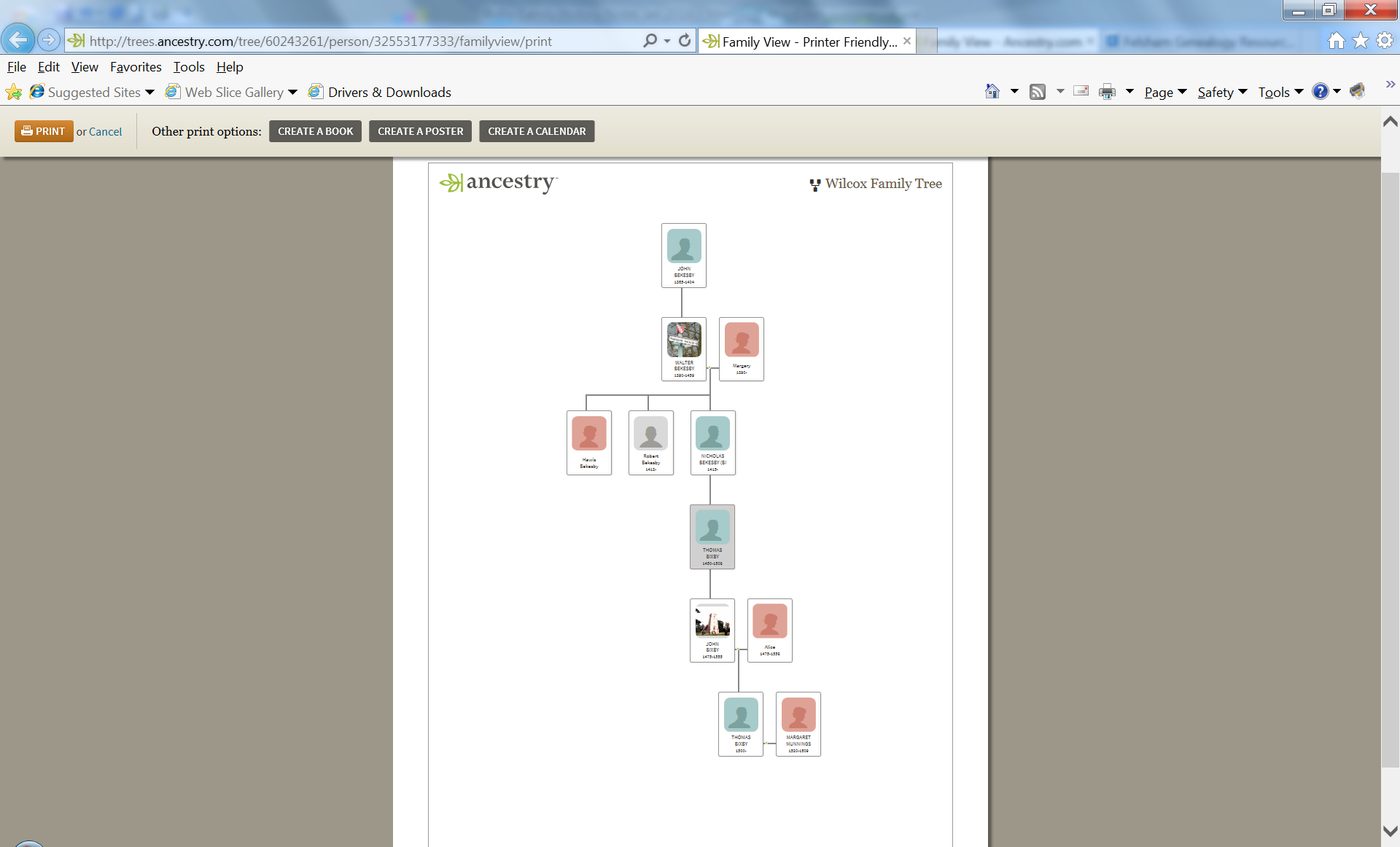
Over the course of time, the Bekesby spelling went through several iterations including Bigsbie, Bigsbee, Bixbye, Byxby, Byxbe. Some changes may have been transcribing or simplification of the name, the pronunciation appears to have remained consistent. In the tree included, I have usually defaulted to the 'Bixby' spelling.
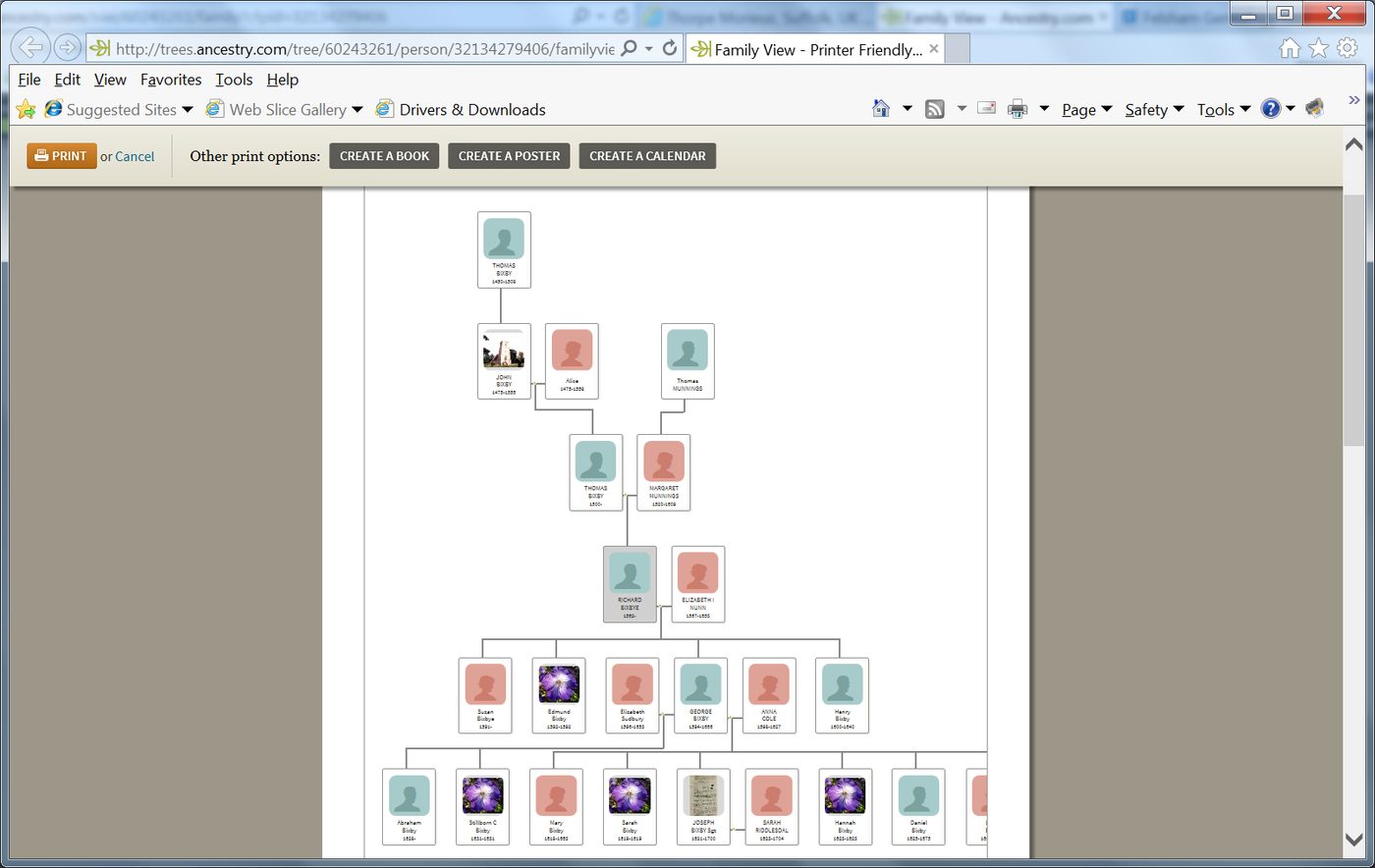
Richard Bixbye was born in 1562 in Thorpe Morieux. At the age of 26, he married Elizabeth Isabelle Nunn of Rattlesden, Suffolk. They moved 6 miles to Rattlesden where both her parents had been born and still lived. There were at least two other related Bixby families living there as well.
Richard & Isabelle had four children, one of whom died as an infant. Their 3rd child, and eldest surviving son, George was born in Rattlesden in 1594.
By the time George was 6 years old (1600), his family (father, mother and older sister) had moved 13 miles to Little Waldingfield, Suffolk where a younger brother was born. Here George grew up and at age of 22, married 18-year-old Anna Cole from Brent Eleigh (3 miles away). It does not appear any other Bixby's were living in Little Waldingfield at this point. Specific records are sparse; however, many in this part of England were a combination of husbandmen (farmer) and tradesman.
George and Anna stayed in Little Waldingfield and had 6 children in the following 10 years. Two of the children died in infancy and Anne herself died at the age of 28 during the birth of their 6th child. Their son Joseph (b. 1621), was the oldest son, and 2nd surviving child. Joseph was 6 years old when his mother died.
It is Joseph who in a few years will immigrate to the New World.
War and Religion, 1337–1611
After hundreds of years of family history in a small section of western Suffolk, England, what would compel a teenager to leave family behind and immigrate to the 'new world'? Perhaps the history and political situation at the time may provide insights to that question. Here is a compressed history of England (1370-1640) and glimpses of Suffolk county specifically.
War
The Hundred Years War, between England and France and several countries they could gain as allies was fought sporadically from 1337 to 1453. "This series of conflict lasted five generations of kings from two rival dynasties for the throne of the largest kingdom in Western Europe, France." Until the 'loss' of this war, England held significant power and holdings in France. "Some of the significant results of this war included:
Feudal armies had been largely replaced by professional troops
Aristocratic dominance yielded to a democratization of manpower and weapons of armies …
England was left with the sense of being an island nation"
The War of the Roses: The conclusion of the Hundred Years War left many English noblemen bereft of holdings in France and scrabbling for holdings and power in the remains of England. This precipitated the War of the Roses (1455 - 1487). This series of dynastic wars was for the throne of England and fought between supporters of two rival branches of the royals. France also had a vested interest in seeing England continue to be unstable, so offered help to keep the unrest alive.
Although 130 years of intermittent war, undoubtedly had an impact on Suffolk County, the impact on western Suffolk County specifically may have been only indirect. This area was not part of any distinguished nobility to be dragged into the power struggles, nor battles fought within its boundaries. This neglect may have contributed to allowing its inhabitants to enjoy more independence and self-direction that will reveal itself in later rebellion. 2
Religion
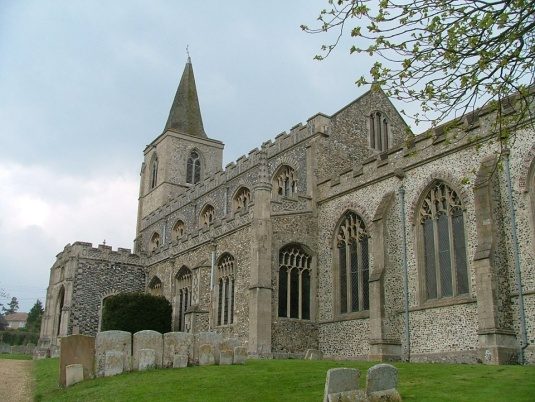
The Catholic Church led by the Pope, administered by Arch-Bishops, Bishops, Cardinals and Priests, was the religion of England through and after the Middle Ages and held powerful influence and over all people. In many ways it was thought to be more powerful than the government and Royalty. Each parish had its own church. Even though Felsham, Thorpe Morieux, Rattlesden and Little Waldingfield were small rural parishes, they had churches that have been restored through the ages.
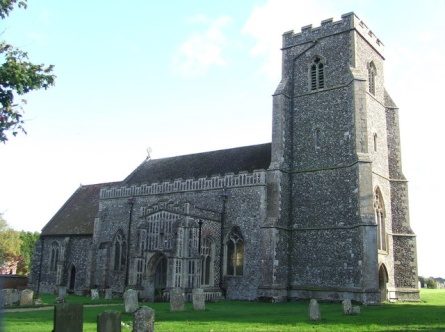
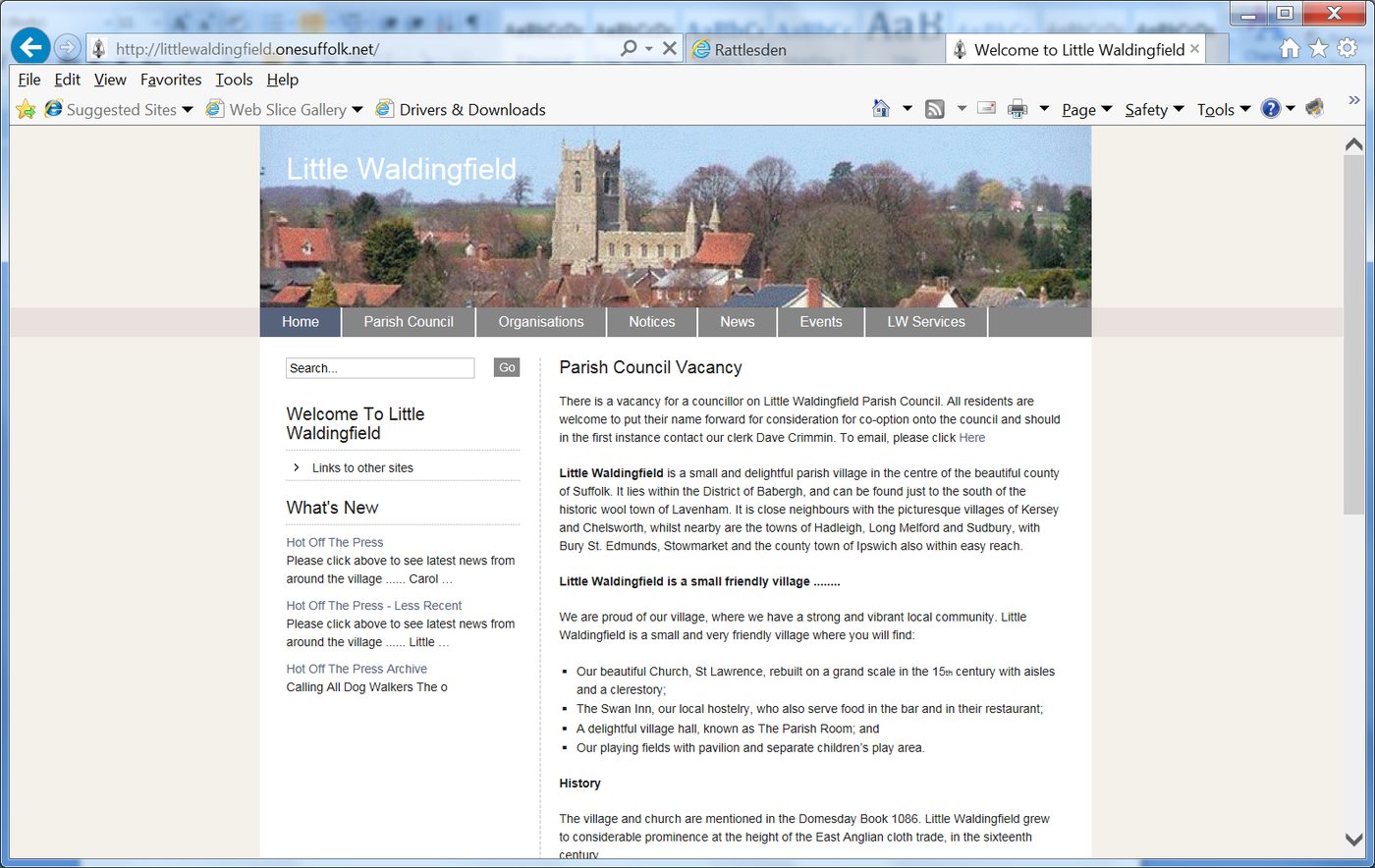
"During the 1300s and 1400s the old religious and social certainties began to give way. A strong pressure toward church reform began to develop and the church and the state (whose nucleus was the royal court) came to be at odds. The royal court also came into conflict with the rest of the aristocracy, i.e. the nobility, and there was a good deal of jockeying for power between them. The English parliament emerged in an attempt by nobles to limit royal prerogatives, particularly regarding their property. Serfdom was on its way out as peasants were in a better bargaining position with landowners because of the labor shortage created by the plague."
John Wycliffe (1320-1384) , was a seminary professor at Oxford; translating the Bible into Middle English (completed in 1382) and was attempting to reform the Catholic church from within in, specifically, he:
Claimed private interpretation of the Bible as the best guide to a moral life,
Attacked the privileged status of the clergy and
Attacked the luxury and pomp of local parishes and their ceremonies.
Followers of this early attempt at reform were called Lollards. This attempt to reform the church was crushed decisively, but it continued to smolder. ,
The Reformation:
"In 1517, in one of the signal events of western history, Martin Luther, a German Augustinian monk, posted 95 theses on a church door in the university town of Wittenberg, GERMANY. That act was common academic practice of the day and served as an invitation to debate. Luther's propositions challenged some portions of Roman Catholic doctrine and a number of specific practices.
The movement quickly gained adherents in the German states, the Netherlands, Scandinavia, Scotland and portions of France. Support came from sincere religious reformers, while others manipulated the movement to gain control of valuable church property.
The term Protestant was not initially applied to the reformers, but later was used to describe all groups protesting Roman Catholic orthodoxy."
King Henry VIII and the break from Rome:
1521: Henry writes a book defending the Catholic Church against the reformation and the Pope gave him the title, "Defender of the Faith".
1529-1536: Initially desiring Rome to approve a divorce from his 1st wife (a devout Catholic who refused to be 'put away'), Henry becomes more angry and ambitious when his wishes weren't granted. Over a period of a few years, he is successful in subverting the power of the Pope and taking over the church in England and appointing himself as its head. Only bishops and priests swearing allegiance (Oath of Supremacy) to the King as head of the church were left in their positions.
English citizens were confronted with a two-fold conflict against their historical religious center, the Lutheran split with the Catholic Church and England's split replacing the Pope with the King.
In 1538, Thomas Cromwell, Lord Chancellor of the realm ordered each parish to record baptisms, marriages and burials. Although a second directive was required 20 years later to enforce the recording, those records are the prime source of information today. It wasn't until 1837 the government became involved in recording such information as well.
1553: Catholic, Mary I became Queen of England (daughter of Henry's 1st wife he divorced). For five years, she tried to reverse the Protestant legislation and restore the previous Catholicism. In the process she ruthlessly hunted for 'heretics', burned 300 people at the stake, fomented religious dissent and ruined the economy.
1558 - 1601: Queen Elizabeth I came to the throne (daughter of Henry's 2nd wife, the one he divorced the 1st wife for and then later had beheaded).
"During the first year of Elizabeth's reign many of the Marian exiles (those who fled from Queen Mary) returned to England. A compromise religious position established in 1559 is now known as the Elizabethan Religious Settlement. It attempted to make England Protestant without totally alienating the portion of the population that had supported Catholicism under Mary. The settlement was consolidated in 1563. …The Church of England under Elizabeth was broadly Reformed in nature…While the Elizabethan Settlement proved generally acceptable, there remained minorities who were dissatisfied with the state of the Church of England. In particular, the cry for "further reform" in the 1560s was the basis of what is now known as the Puritan Movement"
"One of the most important aspects of the Puritan movement was its insistence on having a preaching ministry throughout the country. At the time of the Elizabethan Religious Settlement, less than 10 per cent of the 40,000 English parish clergy was licensed to preach. (Since the time of the repression of the Lollards in the 14th century, it had been illegal for an ordained parish priest to preach to his congregation without first obtaining a licence from his bishop.) …A layman who wanted to hear a sermon might have to travel to another parish in order to find one with a preaching minister. When he got there, he might find that the preaching minister had shortened the Prayer Book service to allow more time for preaching. And, as a trained minister, when he did pray, he was more likely to offer an extemporaneous prayer instead of simply reading the set prayer out of the Prayer Book. Thus we see two different styles developing in the Church of England: a traditional style, focused on the liturgy of the Book of Common Prayer; and the Puritan style, focused on preaching, with less ceremony and shorter or extemporaneous prayers."
This Puritan emphasis on education and preaching will later have significant impact on early American culture and establishing educational institutions.
Elizabeth ruled for 45 years and completed the establishment of the Anglican Church (Church of England), for which she was the head. She stabilized the acute religious turmoil (although it was tentative and continue to smolder).
Her successor, King James I, authorized an English translation of the Bible which was completed in 1611; The King James Bible.
England in the 1630s
SNAPSHOT OF ENGLAND IN the 1630's, the decade of Joseph Bixby's immigration to the New World:
"The British Isles under Charles I enjoyed relative peace and economic prosperity during the 1630s. However, by the later 1630s, Charles's regime had become unpopular across a broad front throughout his kingdoms. During the period of his so-called Personal Rule (1629-40), known by his enemies as the "Eleven Year Tyranny" because he had dissolved Parliament and ruled by decree, Charles had resorted to dubious fiscal expedients, most notably "ship money," an annual levy for the reform of the navy that in 1635 was extended from English ports to inland towns. This inclusion of inland towns was construed as a new tax without parliamentary authorization."
"The Puritan movement had been growing within England for some time. Believing that the Anglican Church had drifted astray (and too close to Roman Catholicism), Puritans sought to "purify" the church from within. Their actions conflicted with King Charles I and his supporters. Still, Puritan ideas grew in popularity. Believers eventually obtained the majority in Parliament - only to have the king dismiss Parliament to rule alone.
The situation worsened for the Puritans with the appointment of William Laud as Archbishop of Canterbury in 1633. Laud was a staunch supporter of the king and the Anglican Church, and therefore determined to get control of the Puritan "problem." He banished hundreds of Puritan ministers and enforced much-hated rituals and formality on their congregations. When people protested, he had them arrested - and even ordered several protestors to have their ears cut off.
"The appointment of Laud coincides with a steep rise in immigration. In fact, only fifteen percent of the settlers that came to New England during the Great Migration came prior to Laud assuming his position. The other eighty-five percent migrated in the seven years of 1634-1640.
"Tax without parliamentary authorization" sentiment leads up to the 1st English Civil War in 1642. Does it sound familiar to, "No taxation without representation" sentiment that leads up to the American revolutionary war in 1770's? English ancestors of American immigrants chafed and had fought over the same issues over 130 years earlier
During or shortly after the immigration of Joseph Bixby, the seeds of rebellion bloomed in England. Religious persecution, taxation and determining what the balance of power would be in England, Scotland, and Ireland turned into the "The Bishops' War", (1640-42) and the, "First English Civil War," (1642-1646). The fighting centered in Ireland and Scotland and continued many years. King Charles was forced to reestablish Parliament to raise the money to fight these wars. Parliament refused to raise funds until issues including Religious persecution were addressed. By the early 1640's Religious persecution had overtly stopped in England AND as a result immigration to America essentially halted.
The Puritans
by Sue Roe
.. series on the largest groups of emigrants from the British Isles to Colonial America. They were: the PURITANS who came, primarily, from East Anglia to the Massachusetts Bay Colony between 1629 and 1640
It is estimated that, between the years 1629 and 1640, about 80,000 Puritans fled from England because of religious persecution. About 21,000 of them came to Massachusetts Bay Colony (the others went to Ireland, the Netherlands and the West Indies). They came from all over England, but most heavily from the East England counties of Norfolk, Suffolk, Essex, Herfordshire, Cambridgeshire, Huntingdonshire, Lincolnshire, and Kent. Of the total, about 60 percent were from these counties. …
The majority of the Puritans were from the middle class of English society. They were educated--two thirds of the adult males could sign their own names--and most of them could afford to pay their own passage. They were usually (about 60 percent) skilled craftsmen or tradesmen. Less than a third of them had been employed in agriculture in England. Those who did farm followed the East Anglia practice of mixed husbandry and a trade. They tended to migrate in families. More than 40 percent were adult men and women over the age of 25 and about half of them were children under the age of 16. The gender ratio was about 150 men to 100 women. Very few were elderly and very few were servants. Those servants who did come were usually already part of the family before leaving England--not part of a labor draft. With the Puritans, the nuclear family was very important and the extended family not as important as in other groups. Therefore, we don't see them migrating in clans as, for example, the Scotch- Irish did. When they settled in the new world, their settlements were the same style that they had been used to in England: Towns, villages, and farmsteads outside of a village but no more than 1/2 mile from the nearest "meeting house". As a group, they tended to stay in the Massachusetts Bay Colony (greater Boston area)--but a small minority did migrate to the Connecticut River Valley. …
The average age for marriage was higher than in any other group of immigrants. For men it was age 26 and for women age 23.
Two thirds of all eldest children in a Puritan family were named after their parents; this was followed by grandparents and other relatives (omitting, of course, any disapproved names). Children were often named for a previous child who had died. …
The practice of "sending out" was used. Children often were sent to stay with other families for training, discipline, apprenticeship, etc. Frequently they left at age 11-12 and completed their training at age 21.
The Puritans valued education. All children were taught to read by parents or masters; schools were available very early; and four colleges were founded in America prior to the Revolution. "
John Winthrop, first governor of the Massachusetts Bay Colony is a first generation Puritan becoming ardently religious in his early teens. He was a lawyer, country squire and shrewd. He was from Bury St. Edmonds in Suffolk County. His father was a merchant who earned wealth was able to buy a title and a manor that had been part of the seizure of Catholic property under Henry VIII. John Winthrop's role and the transformation of what was intended to be a commercial business of the Massachusetts Bay Company into a colonial government is an interesting story. I include the link for those interested.
SUFFOLK COUNTY SPECIFICALLY
By Queen Elizabeth's reign 30-60 years after the break from Rome, individual parishes were haphazard and varied. Her efforts at peacemaking and compromise in the face of competing and conflicting religious convictions (or non-convictions) created vacuums where local leadership could surge. The Bishop in Bury St. Edmunds provided strong Puritan leadership. The transfer of money and wealth from the church to the realm also had a demoralizing effect on the local parish. There were 136 parishes in Suffolk County without a resident ordained minister. Legislation provided a fine for all who failed to attend church on Sundays and Holy days. More severe penalties of imprisonment and death were applied to more serious breaches within the church. Suffolk as a county was already much affected by Puritanism in Elizabeth's reign
PREPARING TO LEAVE
"The technicalities of leaving England were bewildering. Emigrants needed licenses and passports (then a document that allowed one to "pass the port"). After 1634, they also had to have certificates of good conduct from their local minister and agree to take a loyalty oath (to the King of England). Then, the emigrant had to locate a ship. Since transatlantic voyages were still uncommon, finding one could involve a lot of searching and negotiations. For religious dissidents trying to escape unnoticed, these layers of red tape could be particularly distressing.
Besides steering through these bureaucratic issues, emigrants invested considerable time in gathering provisions. Leaders emphasized again and again the importance of arriving prepared. The Reverend Francis Higginson reminded them, "For when you are once parted with England, you shall meete neither with taverns nor alehouse, not butchers, not grosers, no apothecaries shops to help what things you need, in the midst of the great ocean, nor when you are come to land here are yet neither markets nor fayres to buy what you want." By far, the most important provision to bring was food - and lots of it. John Winthrop instructed his wife, who sailed after him, to only bring with her those who "shall have full Provision for a yeare and a halfe for though the earth here be very fertile yet there must be tyme o rayse it."
OATHS
Oaths were used to control behavior by those requiring them with mortal consequences to those taking them (either physically or spiritually). There are several relevant oaths with different names. For our purposes we will point out two.
After Henry VIII declared himself the supreme head of the church (1530's), he required all Bishops, Priests, etc to take an Oath of Supremacy (acknowledging him as head of the church) under penalty of death. His successor continued it. Mary Tutor, trying to restoring Catholic church, repealed it. Queen Elizabeth restored it, etc. It was a long standing tool to keep the population and leaders in alignment.
At the time of Joseph Bixby's departure to the colonies (mid-1630's), Oaths of allegiance to the ruling sovereigns of England were required to leave England. Ships were prevented from leaving port until documentation each passenger had taken the oath was provided.
A Note about OATHS - we will see the practice of Oaths continue into the New World with significant attention as to who is allowed to determine what is in included in the oath and the power that portrays.
The Immigration: Joseph Bixby
THE IMMIGRATION: JOSEPH BIXBY (1621-1701):
It is believed the majority of Bixby's in America (at least up to 1913) are decedents of this one English immigrant. Extensive genealogy research has been done on this family line and published in a book, "A genealogy of the descendants of Joseph Bixby, 1621-1701 of Ipswich and Boxford Massachusetts... " by Willard Goldthwaite Bixby. It is an open source book available to be read online at https://openlibrary.org/books/OL23301081M/A_genealogy_of_the_descendants_of_Joseph_Bixby_1621-1701_of_Ipswich_and_Boxford_Massachusetts
Question: It appears Joseph Bixby, eldest son, departed to America without family probably as a teen-ager. WHY LEAVE? When Joseph was 15 (1636), his family consisted of:
Father: George Bixby, 42 yrs old
Step-mother: Elizabeth, 40 yrs old
Older sister: Mary, 18 yrs old
Joseph 15 yrs old
Younger brother: Daniel 11 yrs old
Younger sister: Lydia, 9 yrs old
Younger ½ brother: Abraham, 8 yrs old
Did the family see the oncoming wars and want Joseph to avoid it? Was it fear of religious instability and persecution? Was it lack of land or opportunity in England? Had friends in the community enticed him? Was it the immediate family structure? After Joseph's mother died when he was six years old, his father remarried the same year. His stepmother, Elizabeth Sudbury, 31, had a baby boy the following year (Abraham Bixby b. 1628) and a still-born child 3 years later.
Answer: A recorded answer to that question has not been discovered. What do you think? Perhaps it is a combination of all the above?
Question: Did he go alone?
Answer: Probably. His name has not been found on a ships roster, so we don't know his specific traveling mates. Search of records do not reveal any others with the name of Bixby (of any spelling). Search of maternal maiden names of Munnings, Nunn or Cole in M.B.C., Ipswich Mass or known pilgrim ships during this time to Massachusetts did reveal Munnings from Rattlesden, but he went to Watertown MA and a Robert Coe from Thorpe Morieux unknown where he went. They may have been related, but not likely they traveled with Joseph. So it is not likely any other family members went with him. We have found others in Ipswich MA from Little Waldingfield, England, however they traveled early, probably before Joseph. Others from nearby small communities in Suffolk County are found in Ipswich MA and later Boxfield Mass., however it is not known whether they were known to each other in England.
Question: Why go to Massachusetts?
Answer: While immigrants were traveling to several destinations, Massachusetts could have been attractive because others from Suffolk County had already gone there. As noted above the co-founder and 1st Governor of the Massachusetts Bay Colony, John Winthrop, was from Suffolk County. Joseph's future father-in-law and wife were from Assington, Suffolk, England. It is unknown whether they were acquainted prior to arriving in Massachusetts.
While the exact date of departure isn't know, it is probable he departed from Ipswich England (by far the closest point of departure). Of the four ships recorded as departing from there during this time, all went to the Massachusetts Bay Colony.
Question: Was Joseph Bixby a Puritan"? As noted in the section about the Puritans above:
Maybe yes: Where the Puritan's came from - a large number of the Puritans that migrated came from Suffolk (where Joseph lived) and the surrounding counties.
Maybe yes: Where they went to - a large number of those that went to the Massachusetts Bay Colony, Ipswich and later Boxfield Mass. were Puritans. In fact, today Ipswich Mass. describes itself today as "America's best preserved Puritan town"
Maybe yes: When they went - the time period Joseph migrated is in the peak years for Puritan migration.
Maybe No: When in his 40's in Massachusetts, he was not yet a "Freeman", although a landowner and man of good repute. Implies he may not have been a member of the church.
Eventually yes: (See notes about his time in Ipswich). He later became a "Freeman" as documented in the church records.
While we don't have any specific records linking Joseph Bixby's name directly as a Puritans, he certainly was in the right places in both England and America and time period. If he wasn't a member, he was certainly living with them in America. This will be discussed more in the next section.
Question: When did Joseph Bixby immigrate to America?
The exact year isn't known. In 1638 a "Muster Roll" of all able bodied men 16-60 was taken in their section of Suffolk England. Joseph would have been 17. His name wasn't on the roll, but his father's was. So it is plausible that he had already migrated. The first record of him in America is in Ipswich Massachusetts in 1647 at the time of his marriage at age, 26.
END OF ENGLAND SEGMENT OF BIXBY HISTORY
Insight into Joseph Bixby's personality/convictions
"It is in this case that we find the deposition of Sergeant Joseph Bixby given 2, 5th mo., 1674, in which he gives his age as 54 years. Concerning the Leonards, he testified to their rough way of life, and disregard of conventionalities, and of their use of "very bad words, as Divell and Damn yee, and many other words which I have been ashamed to heare, which wicked expressions have been very frequent with them." The good man was much shocked. Daniel Bixby also testified in the case, and from testimony of another, it appears that Benjamin Bixby had been friendly with the family. (Essex files, 21 : 140.)"
Bixby genealogy book page 23
https://archive.org/stream/genealogyofdesce00bixb#page/n7/mode/2up
END NOTES
Captured by the family's researcher, January 2016, from the Felsham History Club · complete and verbatim
Felsham — the village history the compiler saved
From the Felsham History club 1.8.2016 http://felsham.onesuffolk.net/clubs-and-organisations/felsham-history-club/
A brief history of Felsham There has been a settlement in Felsham since Saxon times and perhaps even earlier. The origin of the name “Felsham” is not clear but probably means the “home of Faele”: faele, in Saxon, meaning the good, pleasant or faithful. The late Saxon settlement in Felsham was largely under the control of the Abbey of St Edmundsbury, a situation which continued after the Norman Invasion of 1066.
In 1086, it was recorded that Felsham had a relatively large population of 39 households with enough oxen to cultivate up to a thousand acres of ploughland. Like most Suffolk villages, Felsham was to remain a farming community right up to relatively recent times.
The building of Felsham’s present church began in the early 1300s, and though comparatively small, possesses an imposing and well-proportioned tower which is said to be one of the highest in Suffolk. A Porch, with intricate flint flush-work and detailed carvings around the arch, was added to the north door of the church in the 1470s. Well-off villagers left money in their wills towards its construction and embellishment.
Around the same time money was being raised for the construction and upkeep of a “church house” which functioned initially as a guildhall and then as an almshouse. This building near the church was rebuilt in 1629 when it was described as the “poor house” and again in 1829 when it was referred to as the “town house”. This building now contains the village Post Office.
Throughout the medieval period Felsham possessed both a weekly Friday Market and an annual Fair held during mid-August. This Fair was well-known for dealing with the sale of lambs during the Tudor period but by the mid-nineteenth century it was described as a mere “pleasure fair”. As the market and fair withered away local shops began to appear. There has been at least one shop in Felsham since the early 1700s.
There was a school in Felsham from the early 1800s, though it was not until 1854 that a small, purpose-built National School was constructed just beyond the southern edge of the churchyard. In 1899 this building was demolished and a new larger School built on land between the Rectory and the Church. This was in use until 1945 when the school was closed and the children transferred to Rattlesden School. The building is now the Village Hall.
Felsham features many remarkable timber-framed farmhouses, mostly built during the 16th and 17th centuries, and often surrounded by moats dating back to medieval times. Good examples are Capel farm, Stone farm and Moore’s farm. Five of the Felsham farmhouses have nearby barns with “listed” status.
The list of notable Felsham people includes: Baldwin Cocksedge, gentleman, who left a Will, dated 1469, in which he describes in some detail the contents of his moated farmhouse and garden. This was almost certainly situated on one of the moats at Brook Hall Farm. The Risby family, wealthy clothiers, who provided Felsham with a succession of Lords of the Manor from 1640 to about 1740. Their coat of arms can be seen on the flagstones in the chancel of Felsham church. Rev Thomas Anderson, who was Rector of Felsham and local magistrate from 1822 to 1872, and who spent much of his wealth improving The Rectory near Lower Green and in building Felsham House on the Bury Road for his unmarried daughter. Sir John Tilley who inherited Felsham House from the Anderson family and who lived there from 1931 until his death in 1952. He had a long and distinguished diplomatic career and was Ambassador to Japan in the late 1920s.
Every effort has been made to establish copyright and ownership of all material on this website. Please contact admin if you have any queries.
The family's earlier research document · complete and verbatim
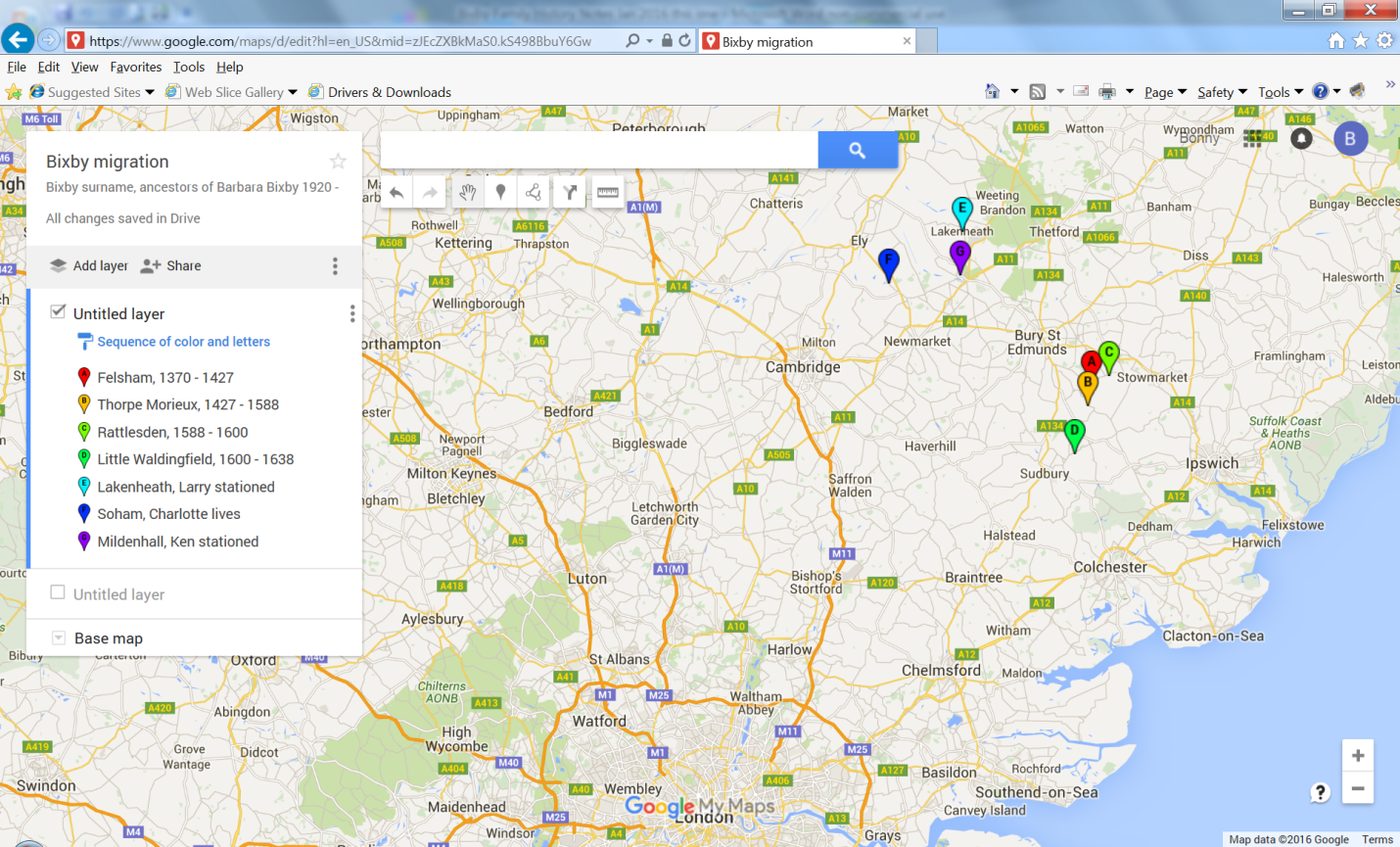
Map of original Bixby migration — January 2014
Bixby Ancestry – Joseph Bixby the Immigrant from England to USA.
The first record of a derivation of the Bixby name appears in Thorpe Morieux, Suffolk (county) England in 1427 as Walter Bekesby buying land. While there are not records through the next 140 years, it is believed this is the direct line of ancestry for the immigrant Joseph Bixby. Documentation picks up again at Joseph’s grandfather, Richard. Richard was born in Thorp Morieux, Suffolk England in about 1561. By the time his 2nd child (Susan) was born in 1590 they had moved 5 miles northeast to Rattlesden, Suffolk, Eng. This is where two more children were born, George (Joseph’s father) being the last (4th) in 1594. By the time George was 23, he had moved 13 miles southwest (7 miles beyond the original family home in Thorpe Morieux) to Little Waldingfield, Suffolk, England. There, in 1716, he married and subsequently had 6 children in 10 years. Joseph Bixby was born, 28 Oct 1621, in Little Waldingfield, Suffolk, England. He was the 3rd of 6 children (4 surviving infancy) and oldest son of George and Anna (Cole) Bixby. He was 5 ½ when his mother died. Seven months later his father re-married and had two more children; only one surviving infancy. Joseph appears to have been born and raised through perhaps the teens in Little Waldingfield (parish name) Suffolk, England. The date of his immigration to the USA is unclear. He does NOT show up in English records with his father as would be expected in 1638 for males 16yrs old or older. The date of first documentation in the USA is 1647 immediately prior to his marriage. There is only speculation as to why a young man would leave his generations of family behind and venture across the sea in the mid-1600’s. It does not appear any other family members immigrated with him. Although immigration records show two other men from his parish going to the same town in Massachusetts, there are no dates on the records to indicate whether they traveled together.
A Little Waldingfield, Suffolk, England B Ipswich, MA [GET DIRECTIONS]
"We could not calculate directions between Little Waldingfield, Suffolk, UK and Ipswich, MA"
A Ipswich, MA B Boxford, MA C Chelmsford, MA D Francestown, NH
Suggested routes: US-3 N 73.1 mi, 1 hour 50 mins Driving directions to Francestown, NH A Ipswich, MA 1. Head southeast on Washington St toward Hammatt St 69 ft 2. Turn right onto Depot Square 367 ft 3. Turn right onto Market St 371 ft 4. Continue onto Topsfield Rd 3.6 mi 5. Continue onto Ipswich Rd 2.7 mi