Introduction
I must begin this with a disclaimer. This began as a brief overview of the horses of the Bar W Bar Ranch to make available to interested family members as we dispose of the original pictures, magazines, clippings, etc. When I realized that more than one person would be interested in them and that younger generations would not have the context to know who the horses and people were from the disconnected papers, etc. I decided to create a brief outline of horses. Then how could you have the horses without the people, and then it got away from me entirely. The following are highlights of the Bar W Bar horses and the Carrol and Barbara Wilcox family and construction. I originally started with horses so that is where I will begin.
Part One
The Registered Quarter Horses
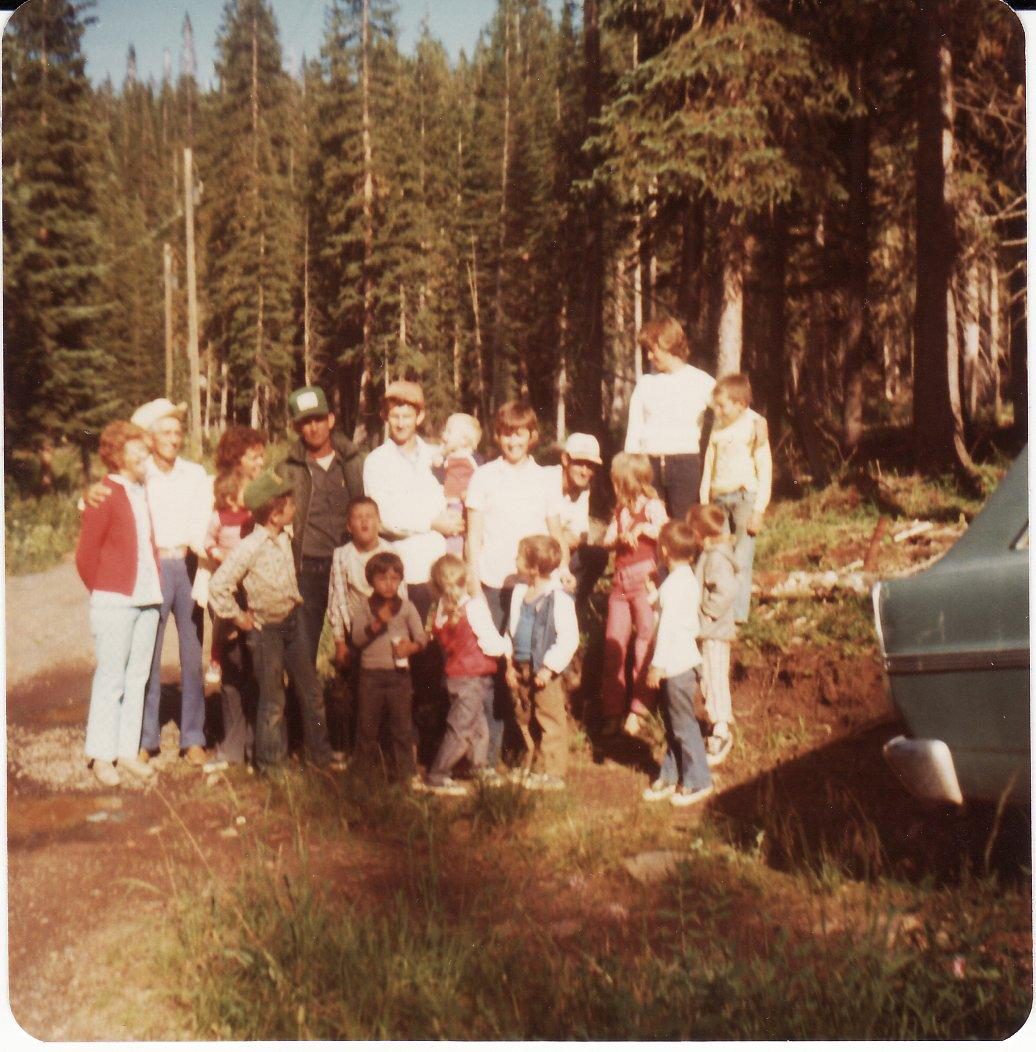
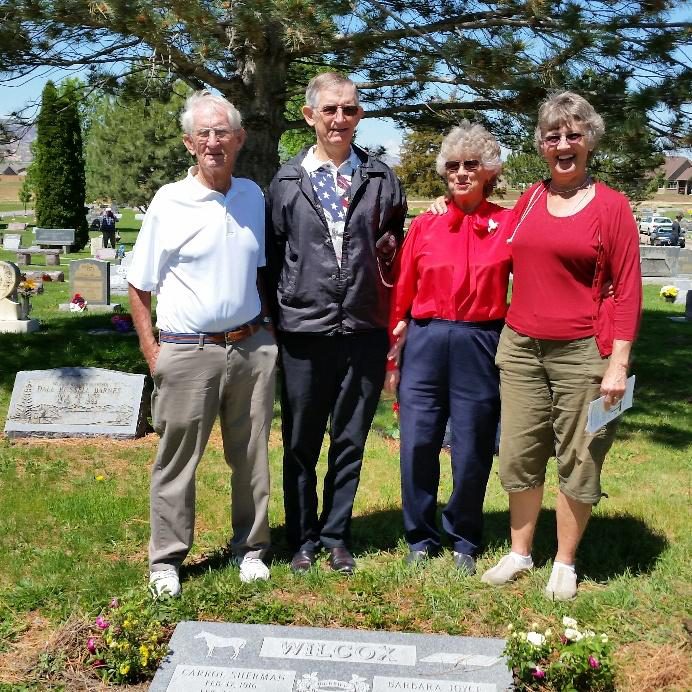
Carrol Wilcox (Dad) 1916–1988, had always loved and had horses. In the mid 1950’s, we moved to a 98-acre ranch at Loma, Colorado where he decided to go into the horse business full-time.
The horse story goes in two parallel lines: Registered Quarter Horses and Pinto horses.
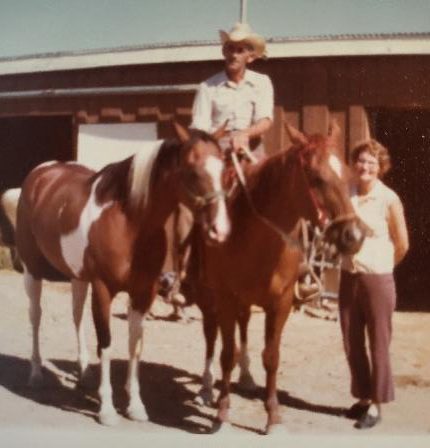
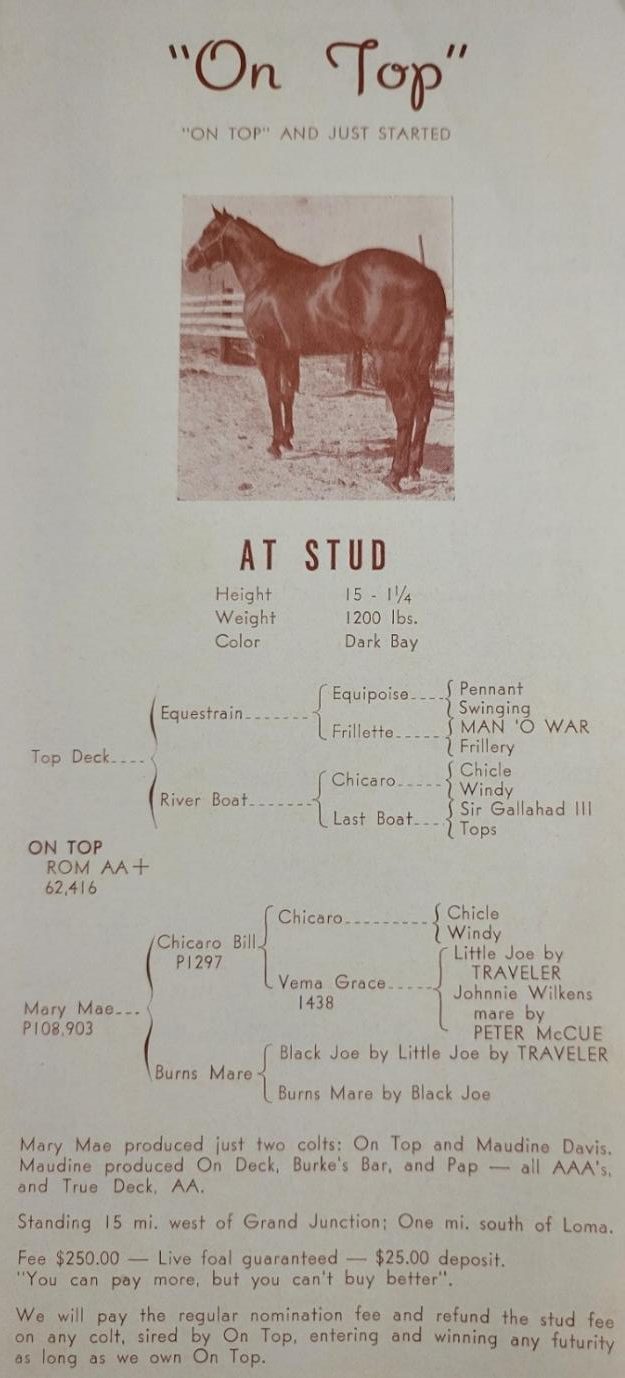
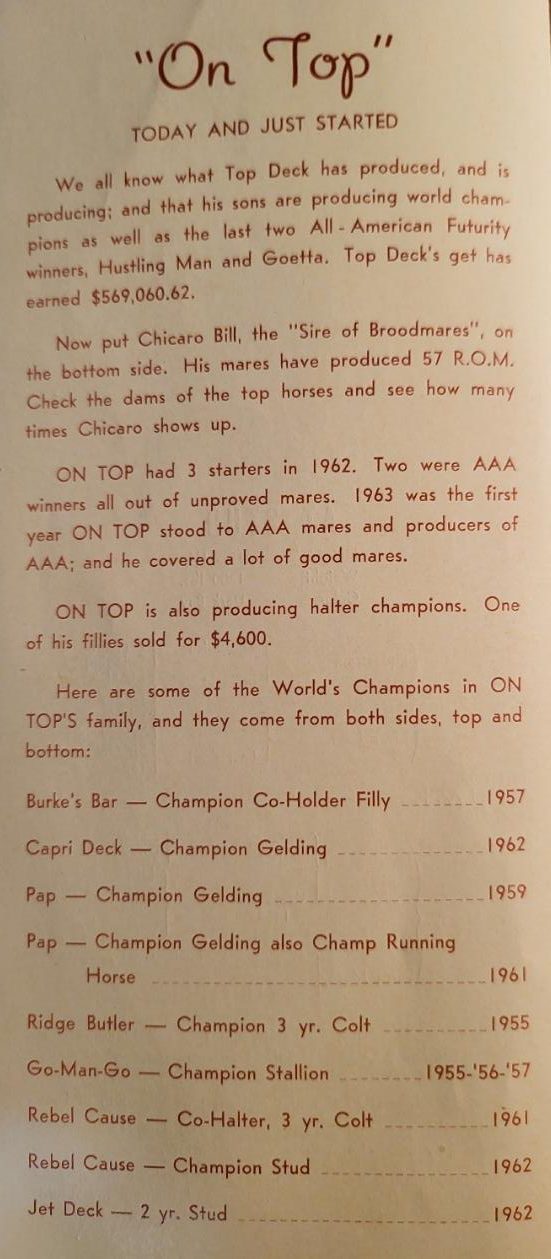
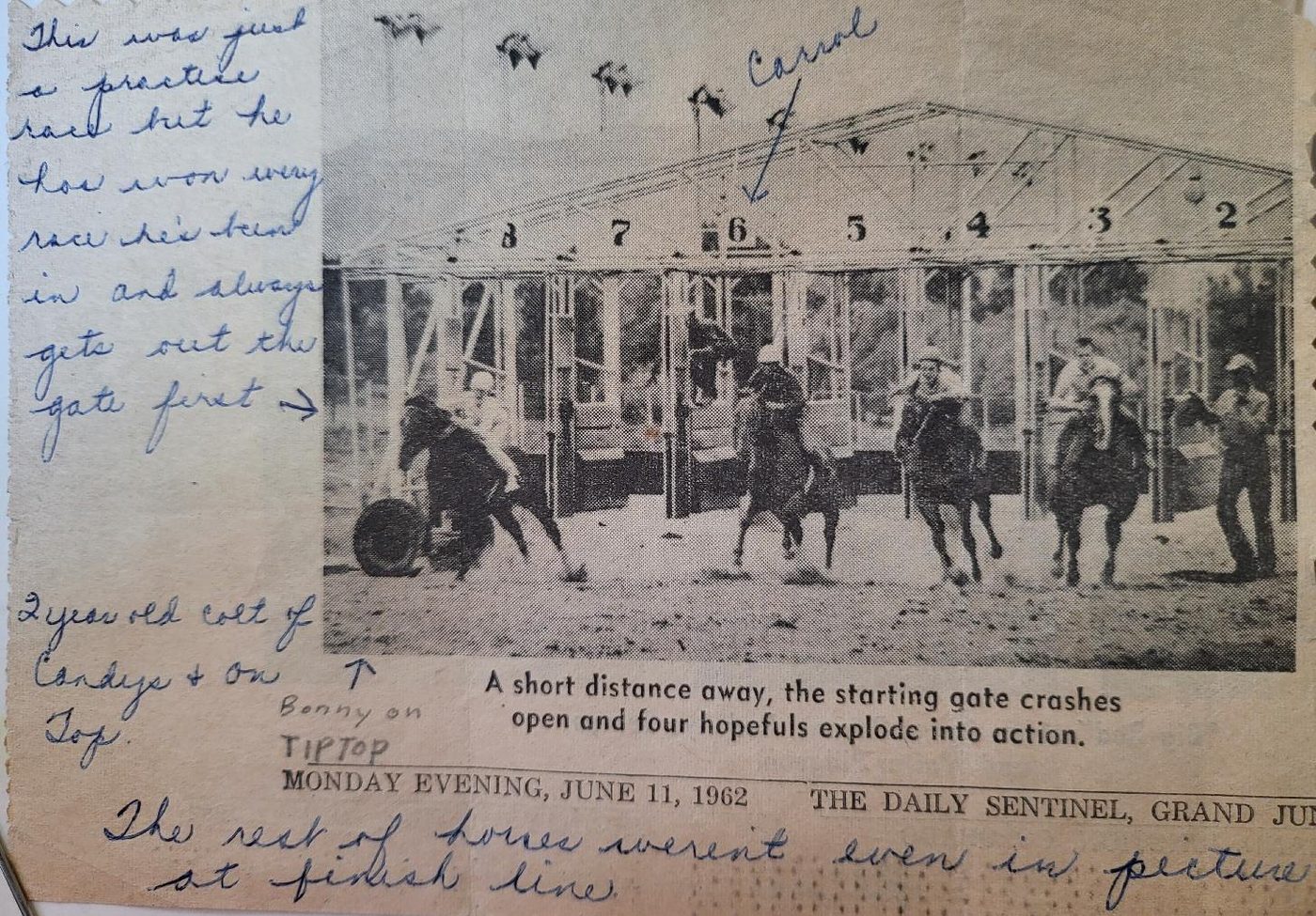
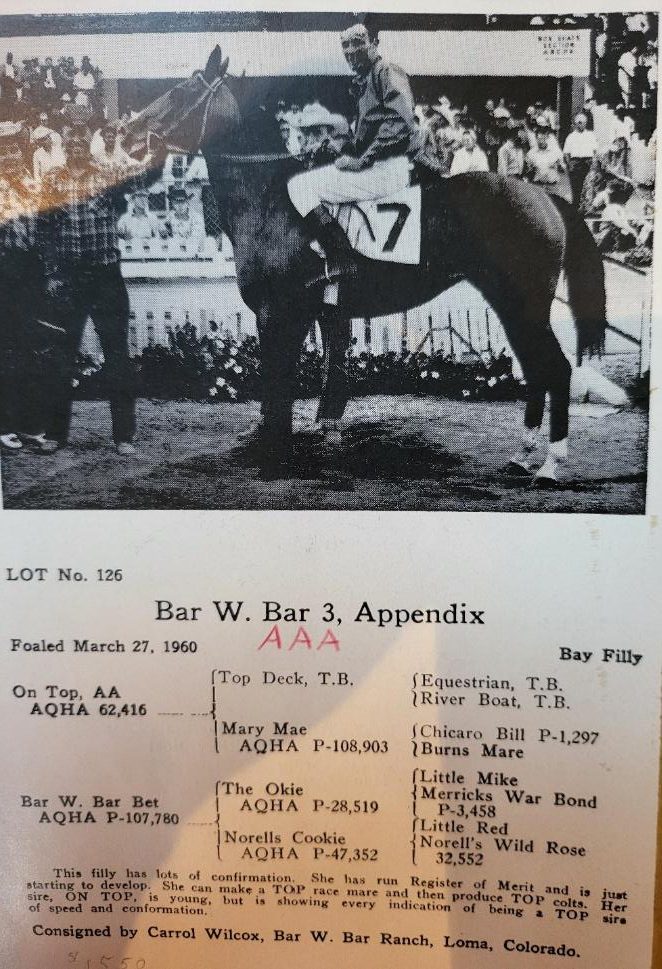
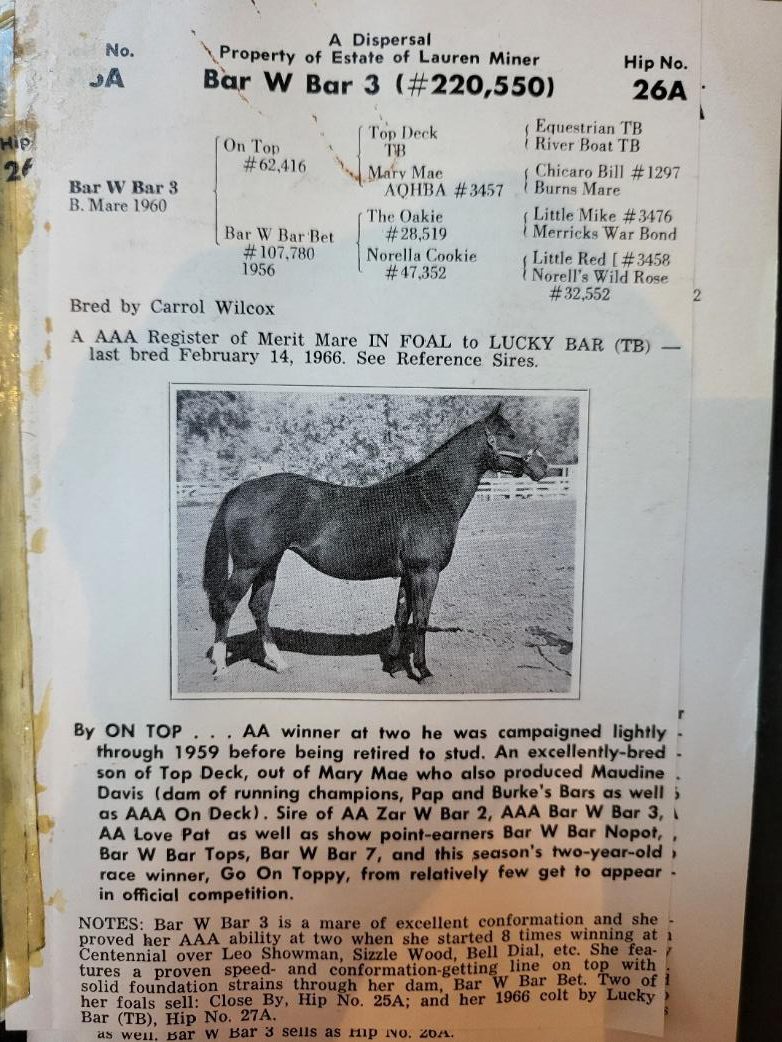
Registered Quarter Horses: Dad bought a proven racehorse to stand at stud. On Top AA+ by Top Deck, born 1952 and I think we got him in 1958. We never rode him. Dad bred many of our mares to him and many mares over the years.
In reviewing this history, I wondered how many total horses we ever owned or how many offspring there were from the two studs. In my head, I believe at one time we had about 35 horses. But over the range of 20 years from mid-50’s to mid-70’s I cannot even guess. I know On Top was completely booked for stud service several of those years. (Don’t ask how many that is, I’m going by mom’s notes). Colts from the mares we owned were all Registered with “Bar W Bar ….” either a name, or when we ran out of names (early) they started numbering them.
While we showed and competed in performance classes, i.e. reigning and Western Pleasure, some trail riding, etc. dad’s real passion was racing.
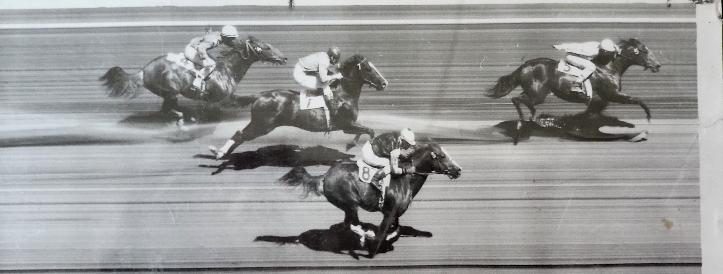
If you are only interested in the horses – skip to page 10.
The Carrol & Barbara Wilcox Family
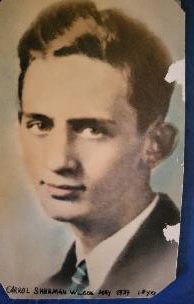
Let me digress for a moment from the horses to introduce you to the Carrol and Barbara Wilcox family. Carrol Wilcox and Barbara Bixby grew up and graduated from high school in the country around Marengo, Ohio during the depression in the mid-1930’s. Carrol was the 8th of 11 children. Their father, Winfield Wilcox, initially farmed then became a Veterinarian. They all contributed to the work of the family. When Carrol graduated from high school in 1934, he had a brief stint in the Civilian Conservation Corps (CCC a government work program for young men during the depression). In 1936, he drove his brother-in-law, Jim Thompson, ‘west’ at the recommendation of Jim’s tuberculosis doctor. Previous neighbors from Ohio had gone to GJ and settled earlier, (Clymers Dairy). That may have been one reason they stopped here. Jim and Dad had carpentry and painting skills they put to work on several projects in the area.
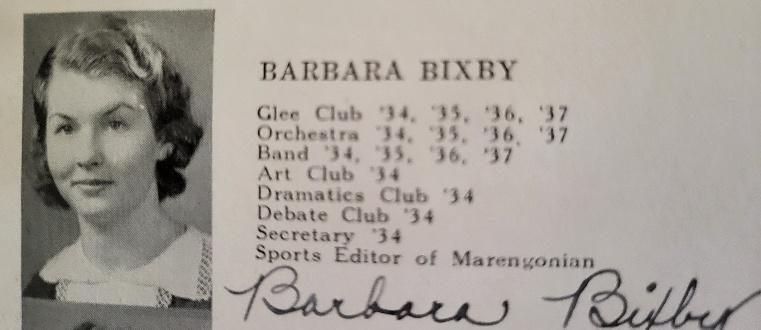
Barbara came from a family of four children, Betty, 3 yrs older than Barbara and two younger brothers, Bob and Bill, 2 and 7 years younger than mom. Their mother died after a lingering painful ruptured gallbladder of a few months duration when Barbara was 12 years old. Their dad remarried and the two older girls went to live with their grandparents in Marengo, Ohio. It was not a joyful home. The two younger boys stayed with their dad and stepmother in Columbus, Ohio. That turning point in mom’s life was the subject of many stories that I did not have the empathy until much later to understand were of painful loss.
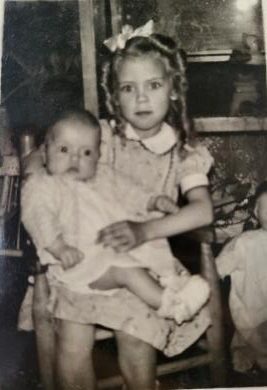
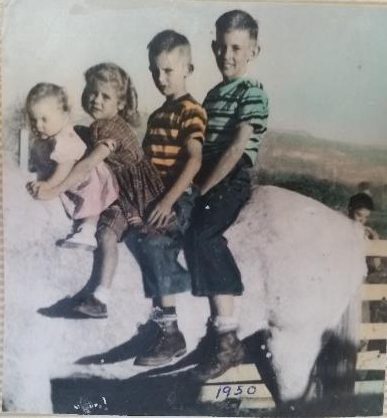
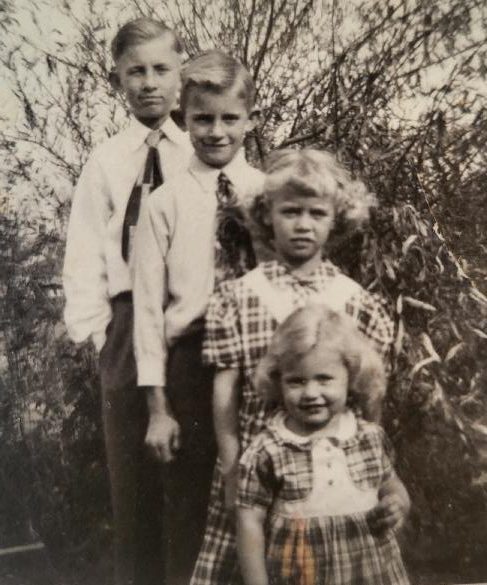
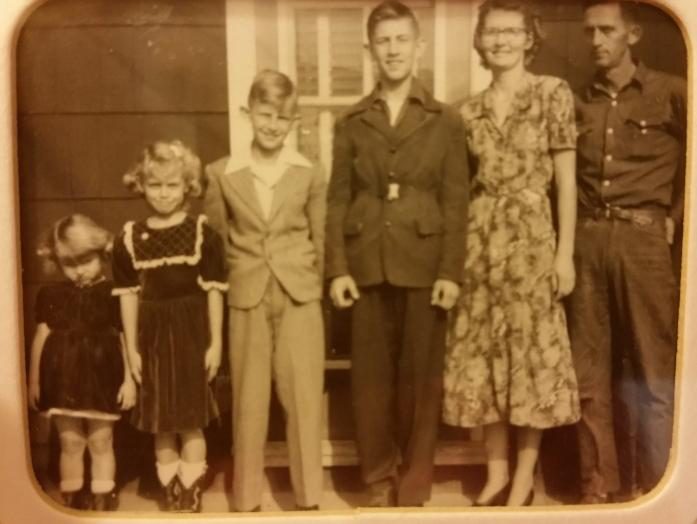
Mom was four years younger than Dad. He had initially been interested in Betty, mom’s older sister, however, she had interests in a different direction. Mom ‘set her cap’ on that ‘older boy’ her sister was not interested in. Somehow a motorcycle was involved. While Carrol was working in Colorado, Barbara was still in school in Ohio. Barbara graduated in May, 1937 at age 16. By her 17th birthday in September Carrol was back in Ohio having saved his money to come back and marry her. They were married in October and a few months later, the job market still not being strong in Ohio, they moved to Grand Junction. Within the following 6 years they had 3 children, Richard, Ronald, and Betty, then 6 years later in 1948, the caboose, me, Bonny.
Dad had continued in construction throughout those years. He did all aspects of the building, excavation, foundation, electrical, plumbing, building the cabinets, door and window casings, build trusses, painting etc. He would go to the Saturday auctions to find old lumber, doors, windows, etc. and repurpose them (before that was a word). That was before so many of the ‘pre-hung’ items available today.
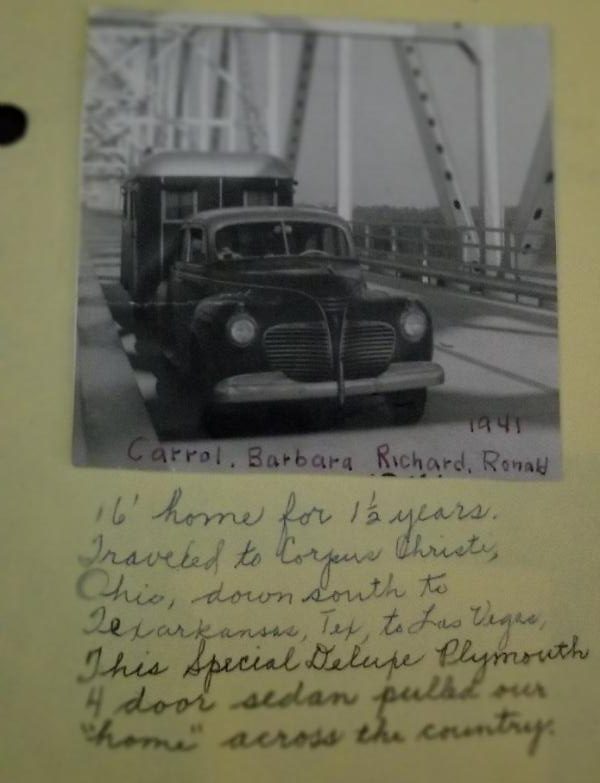
Before Pearl Harbor, the depression was still severe in Grand Junction, but “Defense Construction” was picking up around the country. when Richard was 2 years and Ronald was weeks old, they packed up a small trailer and left Grand Junction to look for ‘Defense Work’. They traveled through New Mexico, Texas and eventually arriving back in Ohio.
In 1935 the Social Security Act began so Mom kept a notebook of Dad’s work along the way. Whereever he could find work (usually painting something) they would stop there to earn some money to continue their trip. His wages were typically a few dollars and cents. She kept track down to the penny. Arriving in Ohio they had relatives to connect with. Part of the time, Dad was employed to help work on Wright Patterson AFB in Ohio.1 Betty was born in Troy, Ohio in 1943.
1 The base exploded from hosting just 40 buildings in 1941 to over 300 buildings by 1944. This rapid expansion included the hasty construction of temporary barracks, military housing complexes, work centers, and warehouses to support a workforce that grew from 3,700 people to over 50,000 https://www.wpafb.af.mil/Portals/60/documents/Index/History-of-WPAFB.pdf
Our Mother, Barbara
Our mother, Barbara Wilcox could not have been a better wife and helpmate for Carrol. Looking back through these archives, I see mom’s hand in the publicity I hadn’t realized before. She was a wonderful stay at home mom who frequently had hot homemade bread coming out of the oven just as the school bus dropped me off. She told Betty and I as long as we helped dad outside, she would do the inside work.
I was always very secure in the stability of our home. Dad wasn’t much of a talker, at least about personal things. I always knew Dad loved me, but as I realized later it was because mom always told me so. I don’t remember Dad ever saying that until I was an adult and said it to him, then he said it back. His way of saying, “I love you” when I was a child sounded like, “Do you think you’ll ever amount to a hill of beans?”, or “You’re a little stinker”. Mom always spoke so positively about dad, always pointed out how hard he worked to provide for us. Neither ever complained or said negative things about the other. I grew up not understanding how rare that was for many families. Of course there were some tense times when you knew things weren’t smooth between them, but no negative talk or bitterness. In looking back, I suspect most of those times were when Dad was not very thoughtful or tender toward mom. We had mom to translate to us that Dad loved us, I think sometimes mom needed that herself.
I have to add a caveat to this discription of our family. As adults when my siblings and I would gather around to tell family stories, it almost seemed like my brothers and I were raised in two separate families. I won’t speak for them, but I do know having a wide age gap in my own children I realize I was much harsher and stricter with my older children than I was 10 years later. But then I also know how frequently it is characterized the ‘baby’ is always spoiled. I leave it there to determine what all that means.
Faith and Gratitude
I thank God I was blessed with the family I had growing up. Mom took us to church every Sunday and provided a role model of a Proverbs 31 wife and mother. She prayed over us and they both loved us and each other. I learned in church that I was a sinner and deserved death as a penalty for my sins. That God sent Jesus, His divine Son, to earth as a man to live that perfect life, I could not, who then chose to die to pay the penalty not for His own sin (He didn’t have any), but to pay the penalty for MY sin. He did that because He loved me with a sacrificial love. I asked Him to forgive my sin and save me from that penalty. Then it took several years before I realized I also needed to allow Him to not just be my Savior. But that I also needed to follow Him in obedience, out of love, not to try to ‘earn’ any favor. That final surrender of following and obeying is where the peace and joy came in.
The older I get the more aware I am of not appreciating mom and dad as a teen-ager as much as they deserved. I look forward to making up for that in heaven with them.
Wilcox Construction
The Homes Carrol Built
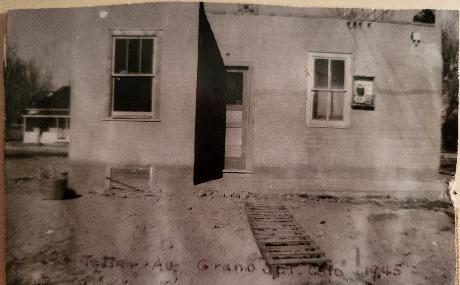
Toward the end of the War, they moved back to Grand Junction. Dad built houses when lumber and materials were very scarce. Their first home after coming back was at 223 Teller Avenue where they lived in the basement while dad build the house over them. Richard and Ron would tell stories of that experience. While they were living on Teller Ave. they bought 2 acres at 2221 Orchard Avenue where they could have horses.
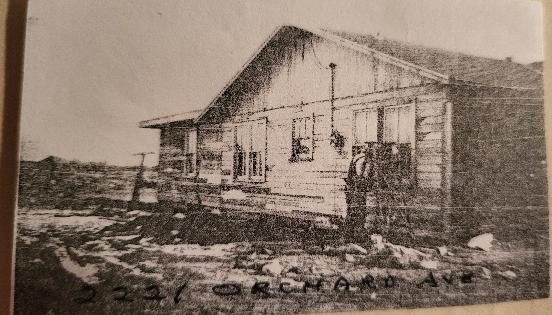
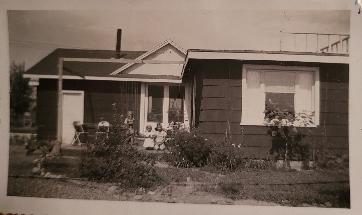
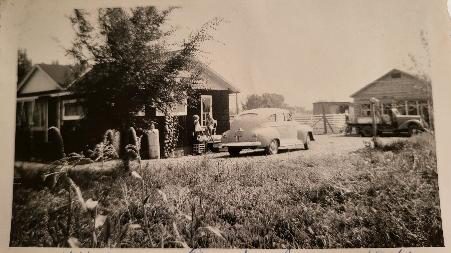
Dad began remodeling the house on Orchard Ave while still living on Teller Ave. They moved in the day of President FDR’s funeral, April 1945. Ongoing remodeling continued for some time after moving in.
This is the house and neighborhood where Richard and Ronald knew all the neighbor kids and adults and roamed with stories of rope swings over the drainage ditch, climbing through the fense into the junk yard, riding their bikes as far as they could go. We had cousins living nearby.
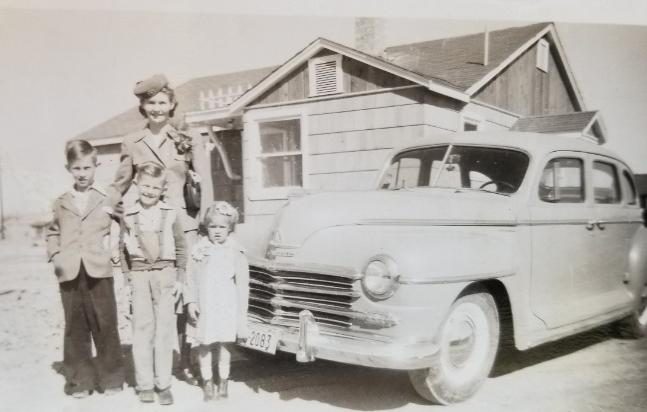
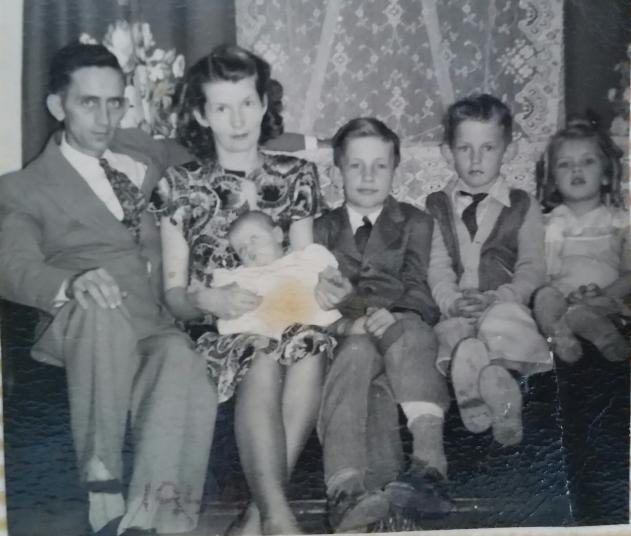
The pasture on the south side of this house ended at North Avenue. On the other side of NA was the new VA Hospital. We have movie pictures of the horses running in the pasture and the VA in the background. Dad started selling lots and building houses at the far end of the pasture, working down toward our house.
Of course, all that ground has been subdivided since then. The current address for this house is 2224 Hall Avenue.
Over the years of Wilcox Construction up to this point in time, (1957) my brother Ron went back and mapped at least 20 houses dad built mostly from 22nd to 24th streets and between Orchard Ave, Elm, Texas and Hall Ave. Brother Ron and I drove around a few years ago so he could show them all to me.
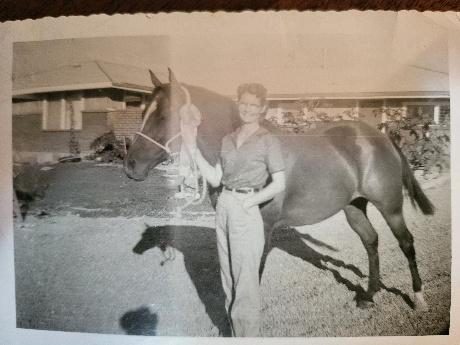
During those early years, they had horses they used for hunting and pleasure. I do not believe those horses were registered. Mom’s horse was “Candy”. She became the mother of Bar W Bar Tops a few years later.
Dad’s horse was Star, who jumped out of the truck on the way to a hunting trip. A sad and tragic accident.
I started 1st grade at Orchard Ave School.
Mom’s Dream House — and the Move to Loma
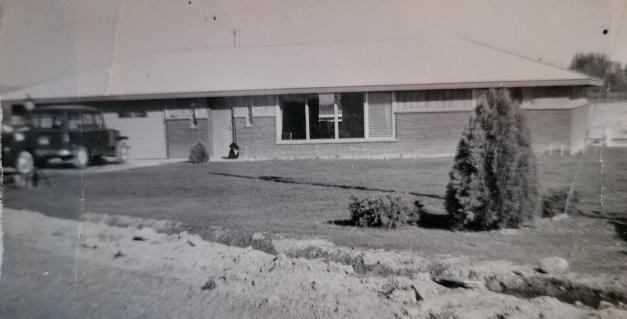
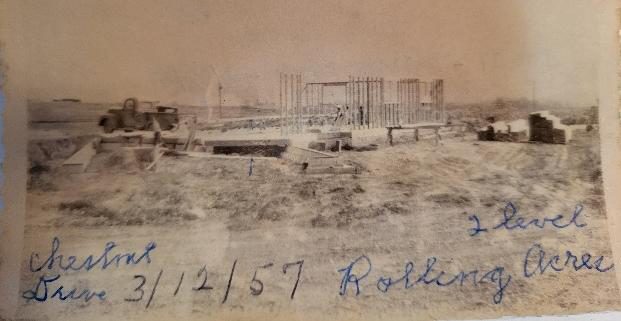
Dad bought acreage on North 7th Street to built mom’s dream house and a subdivision. In 1956, Mom got her brand new 4 bedroom dream home WITH A DISHWASHER at 2466 Chestnut Dr.!
By the 2nd grade I was going to Tope Elementary school.
As dad built out the subdivision, horse pasture was no longer available and there were ‘too many people’ around them. Everyone knew he had built their houses, so when there was a leaky faucet or maintenance to be done, they would knock on his door.
Previously in Feb 1952 they had purchased 98 acres of alkali ground in Loma with an old railroad tie shack on it at a Tax Auction. As the subdivision on 7th steet was consuming the ‘pasture’, they moved some of the horses to Loma. We used to go there sometimes as a ‘family adventure’ to check on the horses and roam around. I remember stepping out of the car onto (into) the alkali, breaking through the top crust of white salt into the mucky black sticky soup underneath. There was an old ‘pond’ (swamp water a few inched deep) smelled bad with all manner of frogs, tad poles etc. It was a big attraction. There would also be haystacks to climb.
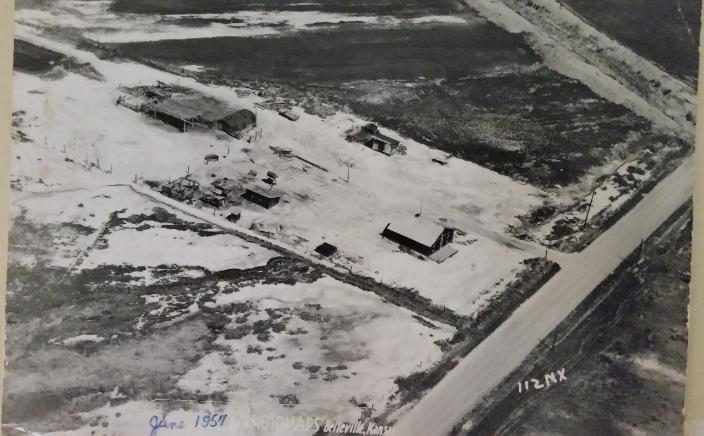
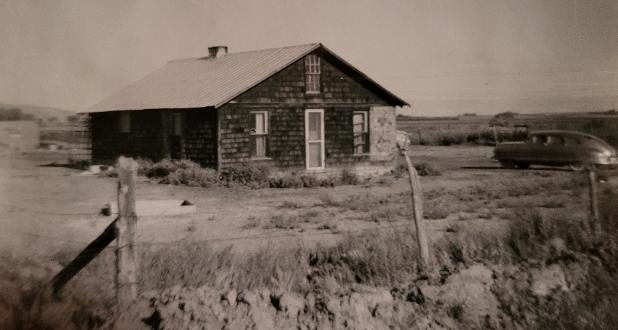
After one year in her ‘dream home’, dad wanted to move to Loma. The house had no indoor plumbing, electricity, one bedroom and a potbelly coal stove to cook and heat. Mom said if he put in electricity, plumbing, bathroom, and two bedrooms she would move in. He did and she did.
We moved to Loma in the summer of 1957 where I started 3rd grade at Loma Elementary school.
Richard had just graduated from Grand Junction High School. He tells the story of going to Florida after graduation to visit Aunt Betty (mom’s sister) and Uncle Merle. Upon returning to the house on Chestnus Drive, he found we had moved and there was no bed or room for him in the Loma house. Shortly after that he and Ron were in the ‘back 40’ digging fence post holes in the alkali when it struck him that joining the Navy was a great idea! He heaved the shovel and started hitch-hiking to town. Ronald was close to graduation and not interested in the horses except for an occasional jaunt. That left, Betty and I. She was in the 9th grade.
Part Two
The Pinto Horses
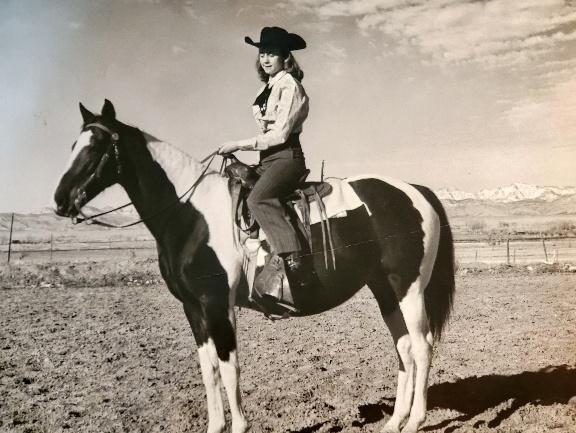
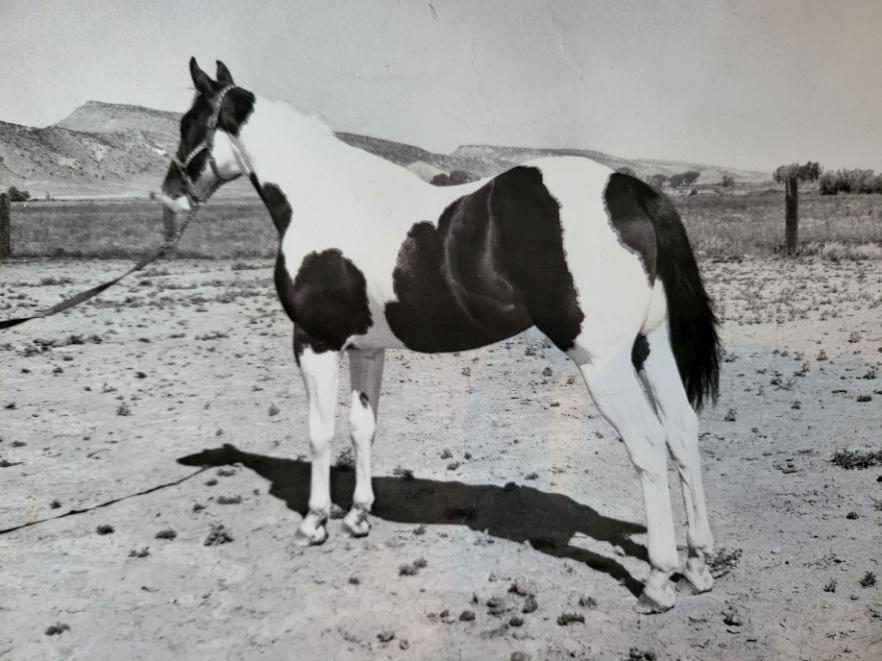
PINTO HORSES: Betty, who loved horses and wanted to be included (and perhaps the folks wanted to divert her attention away from boys — what do I know?). Dad bought her a paint mare who had also previously raced and was used at the track to pony race horses. Some of the articles included explain how she was not really a ‘kids horse’ and Dad and Betty trained Bar W Bar Paint to barrel race, both clover leaf and stake. Over the next years, Betty won many competitions throughout western Colorado at horse shows and rodeos. She was a member of the Monument Riders Club in Fruita and loved all things about horses.
In fact, the year Betty was a senior in high school, she and Paint had earned enough points that Bar W Bar Paint was the National Champion Pinto horse for 1961.
At eighteen, shy Betty had the solo adventure of getting on the train in Grand Junction, Colorado to make a connection in Chacago to New York City for the awards ceremony. That train ride, expanded her horizons in many ways. Ask her about it some time.
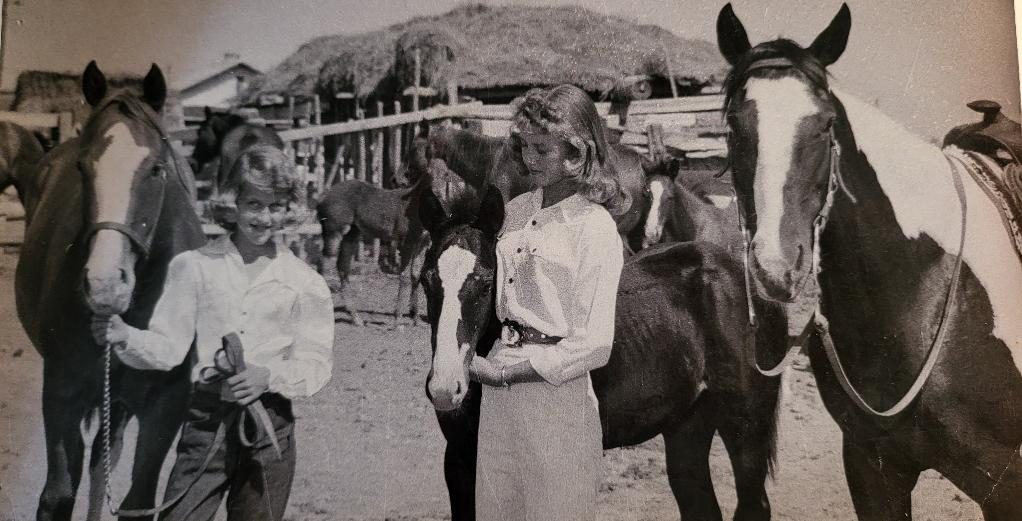
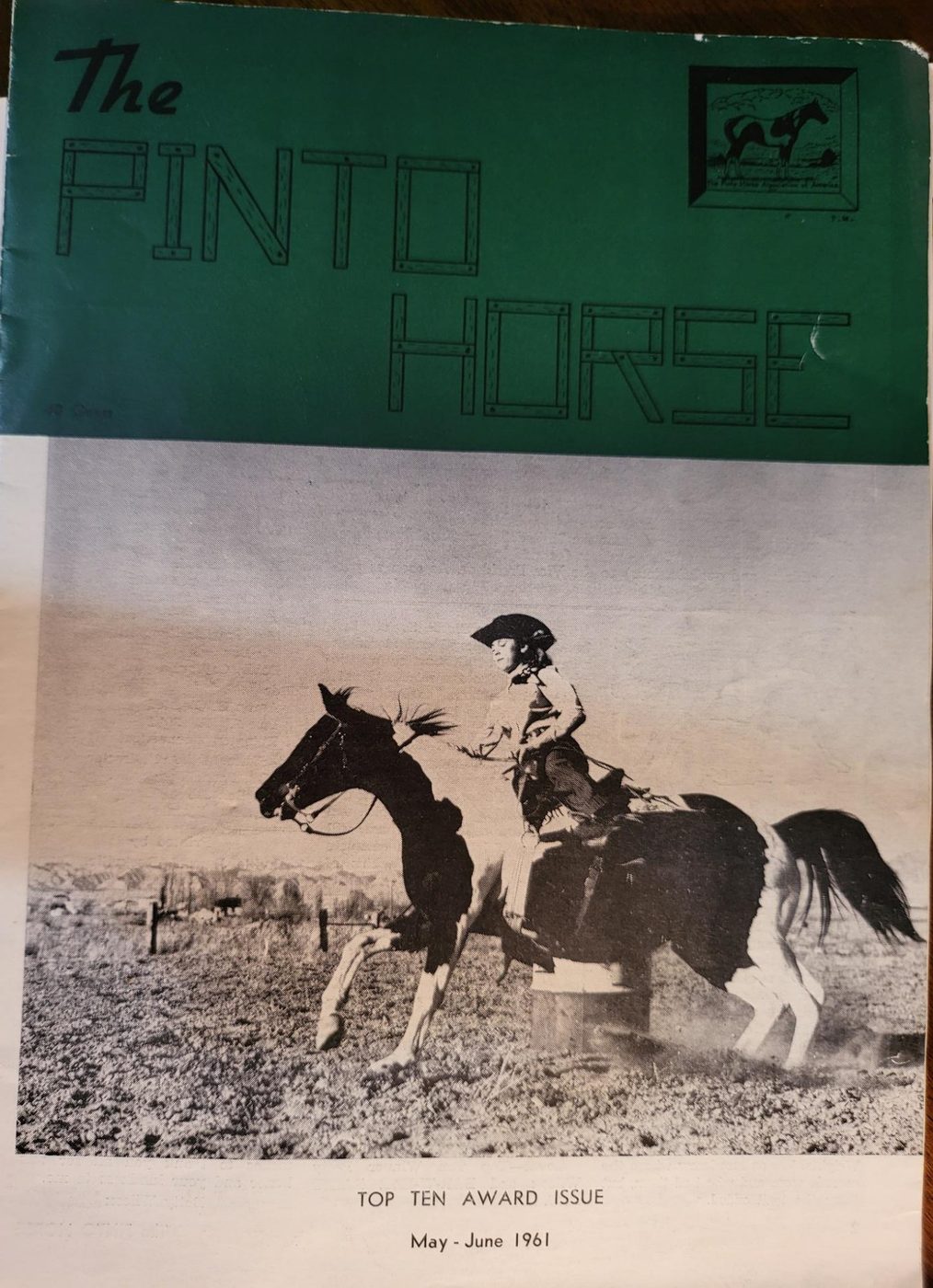
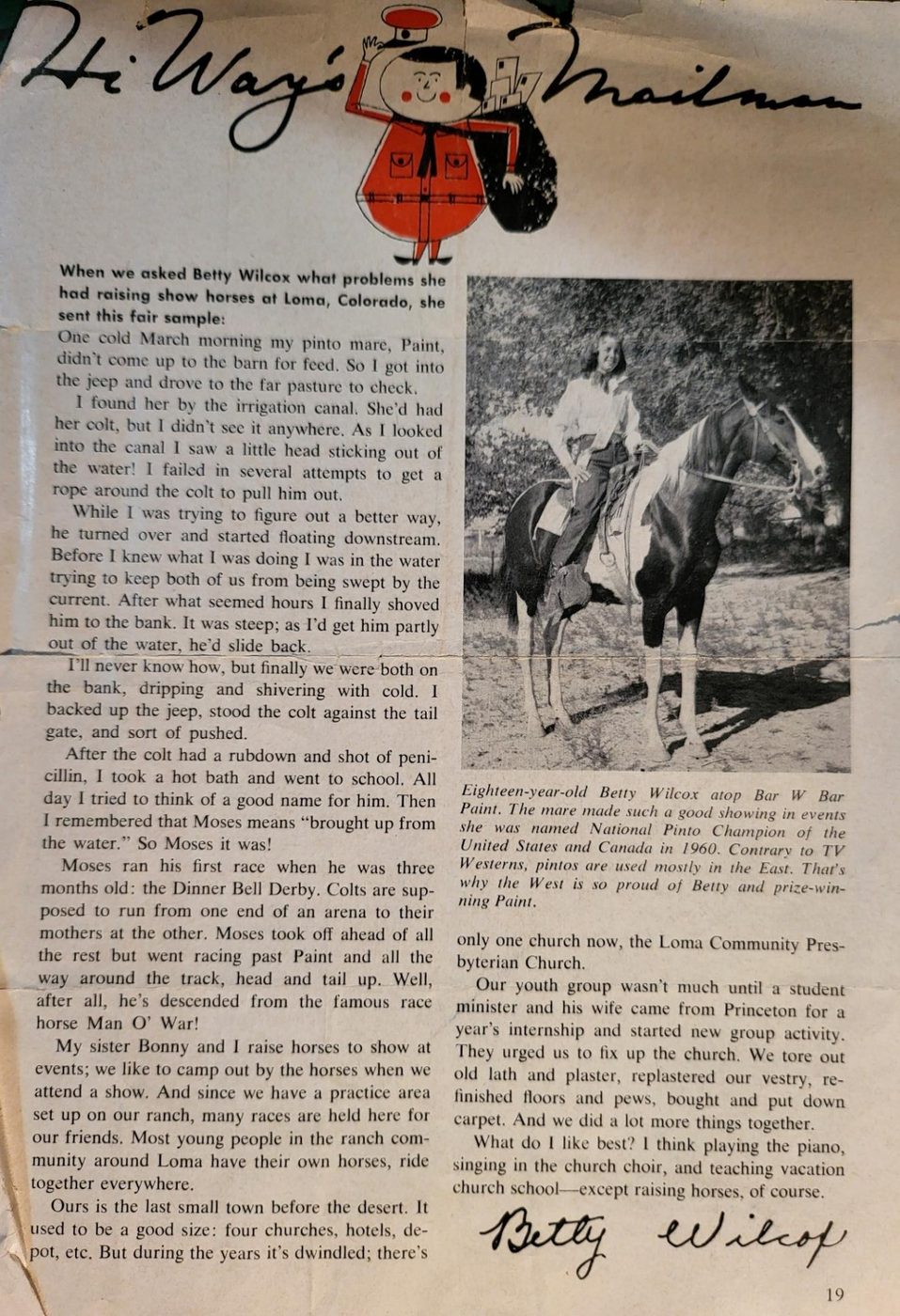
From the Scrapbook
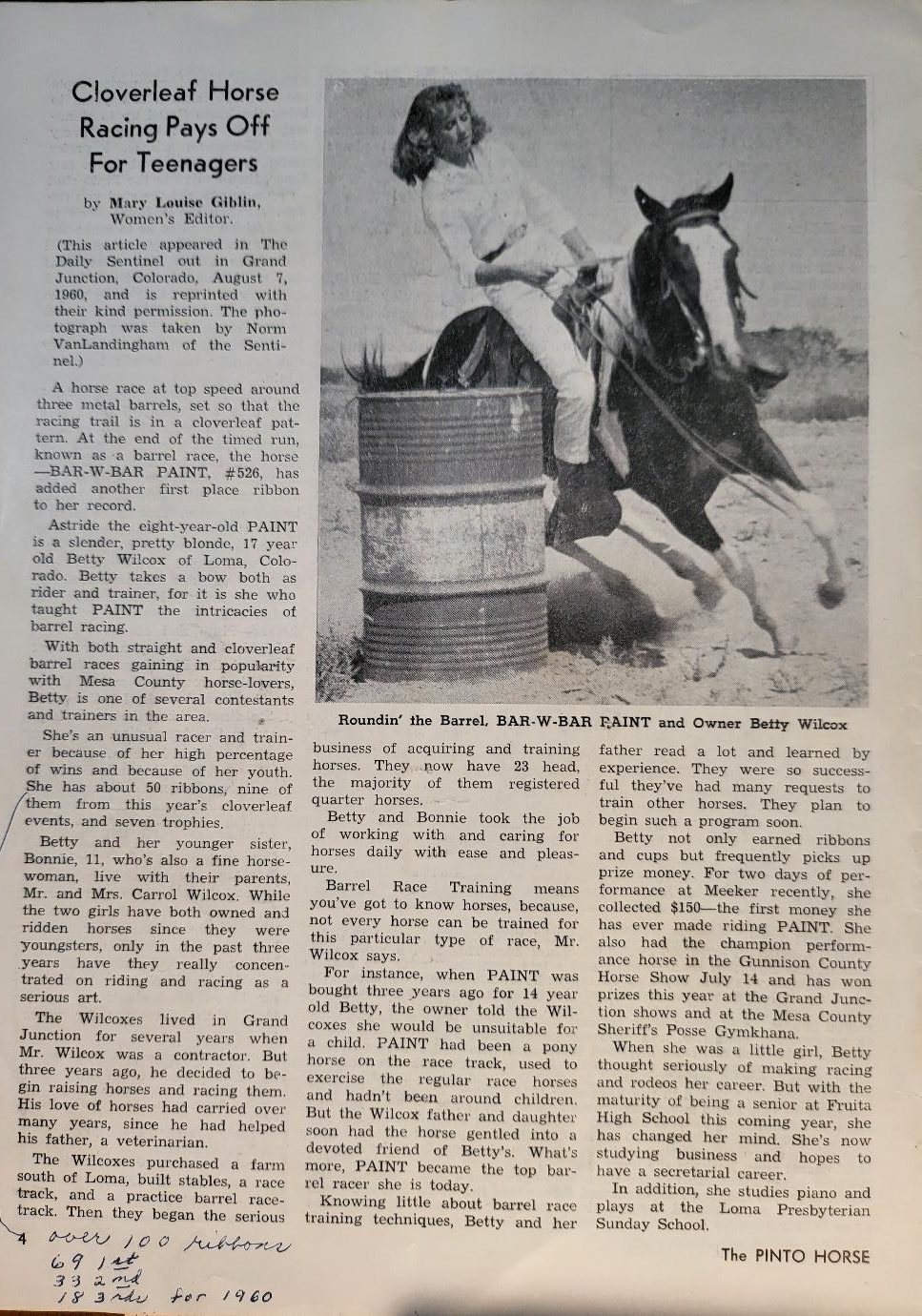
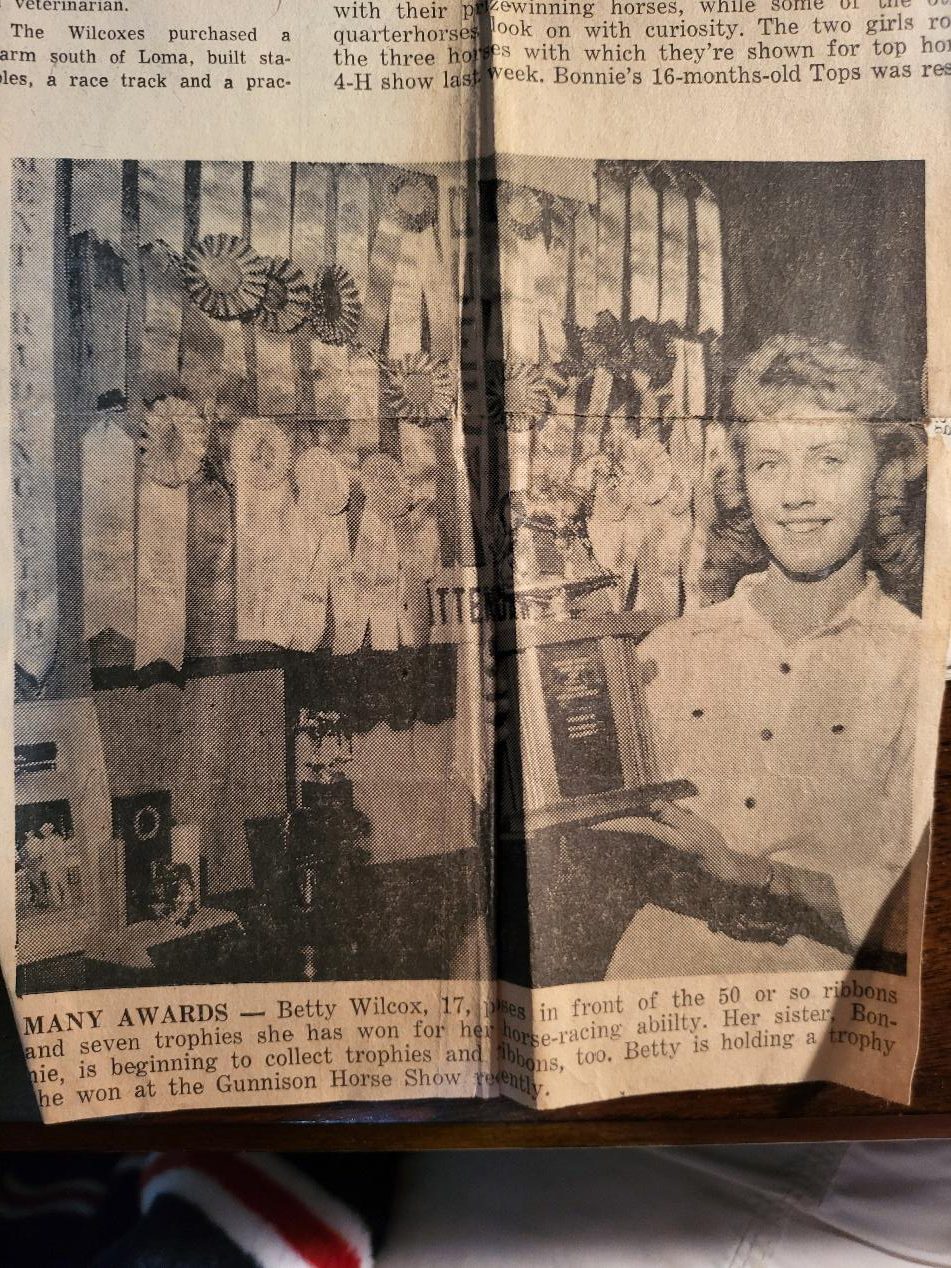
As Betty graduated from Fruita High School in 1961 her life turned in a different direction toward getting a job, getting married and leaving home. There is another whole story line there, but it doesn’t necessarily include horses so we will leave that for another time. Except to say her love for horses and MANY animals persists throughout her life to include, skunks, ferrets, dogs, goats, sheep, parrots, chickens, and I am sure I am forgetting several other species of pets (whether they were intended to be traditional pets or not — she adopted them).
Part Three
Bonny’s Years — 4-H, Racing & Beetlebomb
While Betty was racing barrels, I was in grade school. The first horse I had was ‘Lady Kay”. Dad brought her home from the Saturday sale (long standing stories behind Dad and the Saturday Auction for another time). Lady Kay was 12 years old and had a crippled back foot. I think he saved her from the dog food company. But she had a good bloodline and later produced great colts. She was a perfect kid’s horse for me in the 3rd grade. I got great exercise with her because if she saw you coming in the field she ran away and I had 98 acres to chase her to catch her. I had to plan a day ahead of time for her to come to the corral, use bucket of oats, etc. You get the picture.
After Betty left home, I became Dad’s ‘right hand man’. (That means I got to get up early in the morning to clean the stalls, exercise horses, etc.).
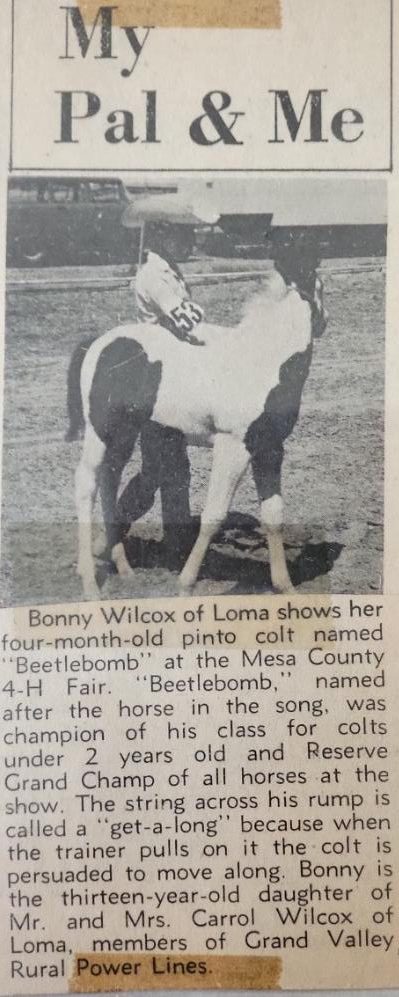
Throughout the years described above, we were also in 4-H with horses. Bar W Bar Tops (Fig. 12, pg. 10). was one of my first 4-H horses. Dad was the leader. Each year a new foal would become my 4-H project as well as a previous horse. It was Dad’s way to gentle and train the new colts. He was still breeding horses with a full calendar for On Top.
Dad’s focus shifted from barrel racing to simply racing. Since I was the last one home and the right size, I became his jockey for training.
At first, Mom went with us to the county fares, Rodeos, etc. but it made her nervous to watch me ride. Later, she stayed home to take care of the ranch.
Bar W Bar Beetlebomb
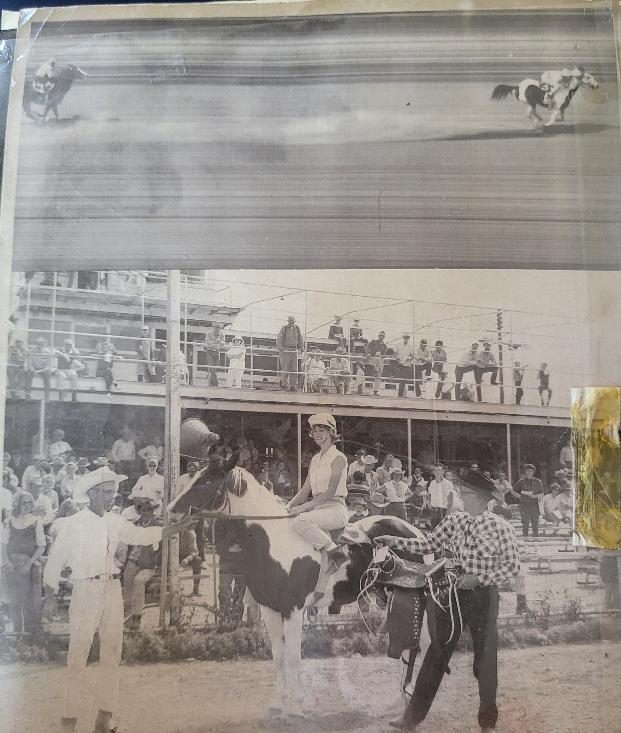
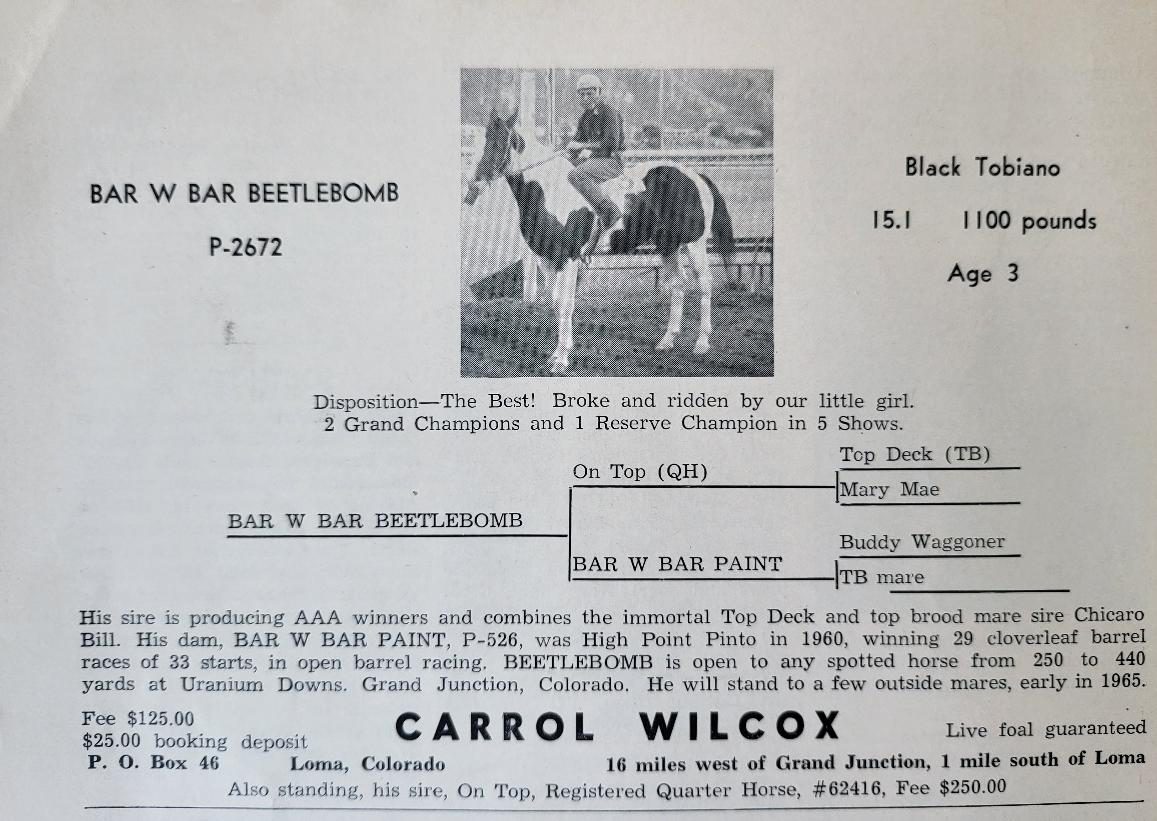
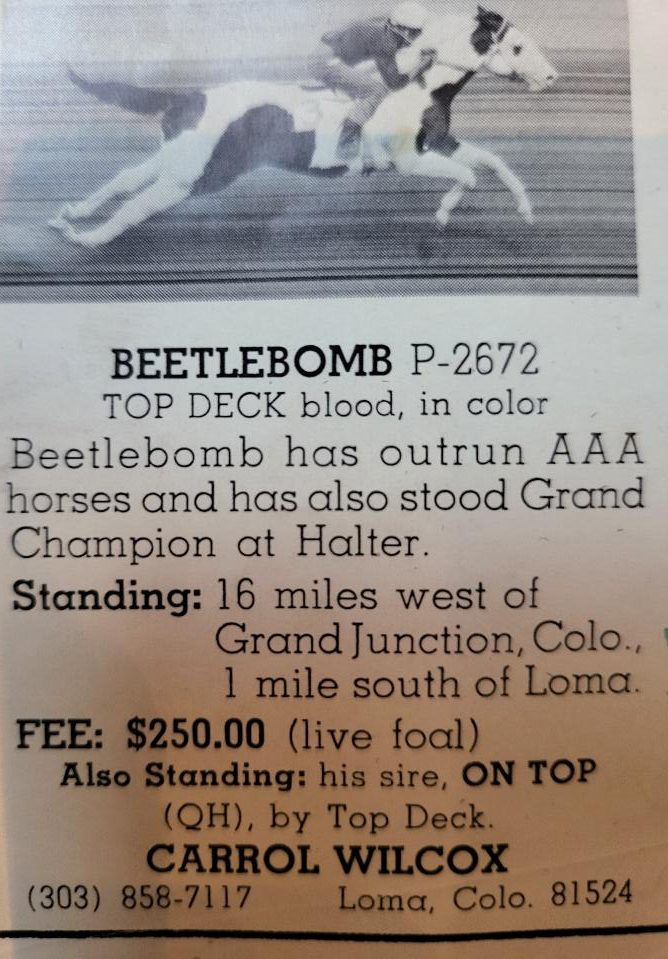
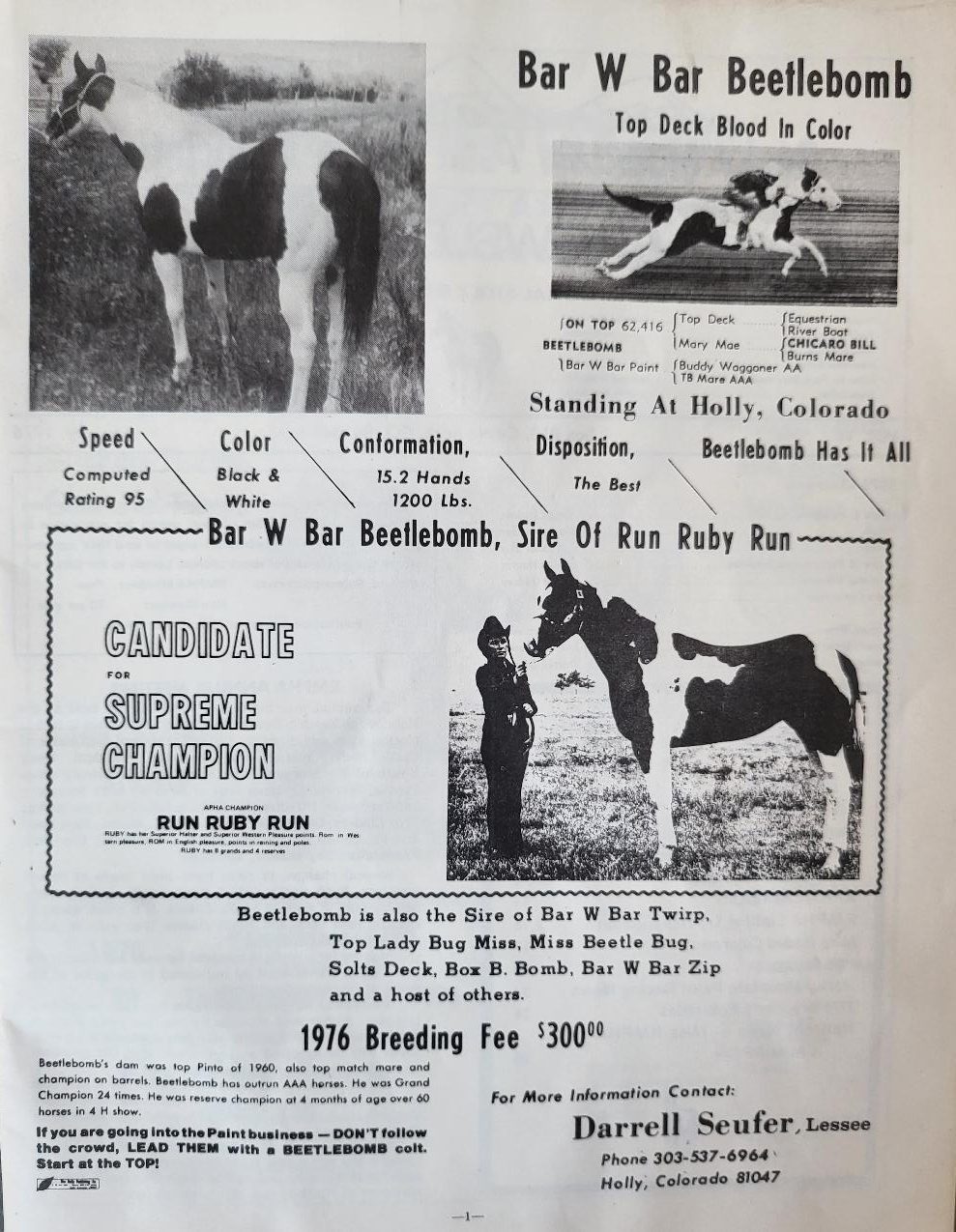
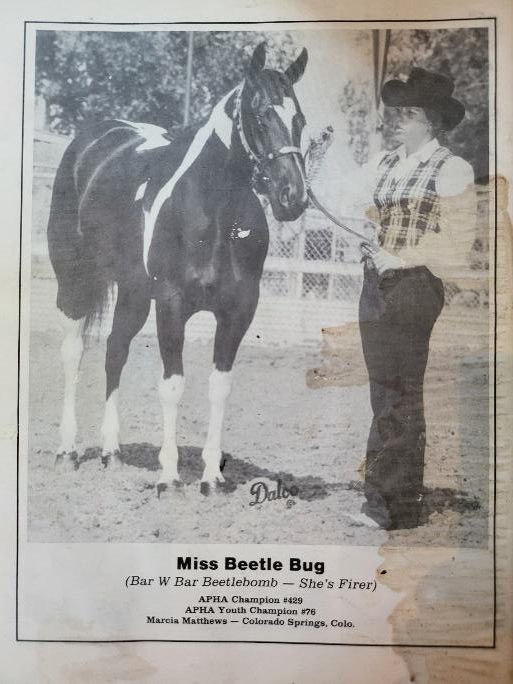
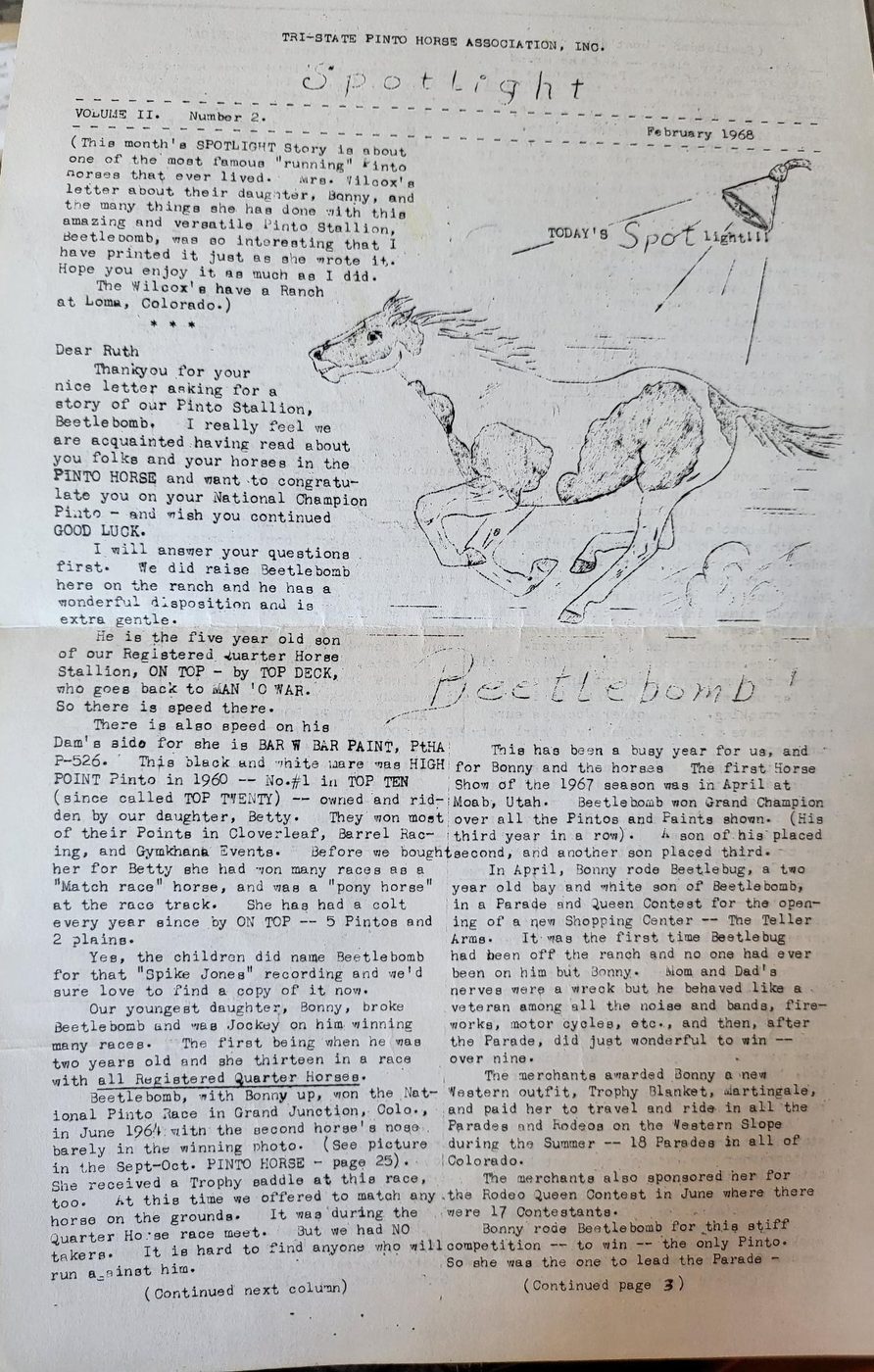
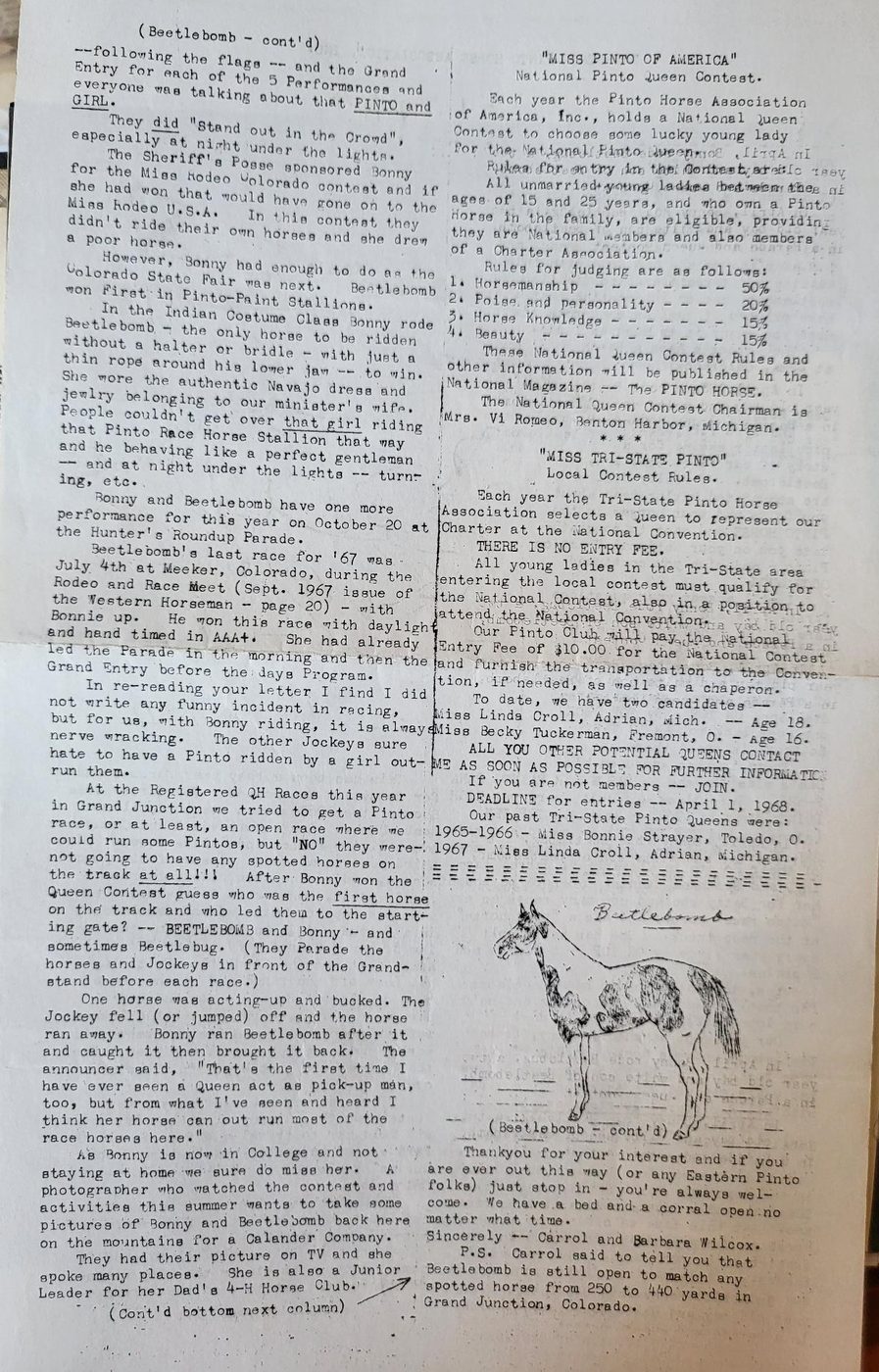
Returning to the leading horses of this story — On Top plus Bar W Bar Paint begat Bar W Bar Beetlebomb!2 He was one of my 4-H projects. For several years I would compete with him in Western Pleasure, Reigning and at Show in addition to racing him. It was unusual to have a horse with that breadth of ability and training. Later dad loaned him out to a friend to train him as a roping horse as well.
When I was in high school, we went to the State Fair in Pueblo and I rode him bareback with just a twine rope in his mouth (no bridle) in a Navajo costume in the “Show” class — we won. The judge could not believe this Stud (yes, he was fully grown by then ) was so well mannered in the ring with mares and controlled by a girl and a binder twine. I wish we had the picture of that class.
2 If you are interested in the origin of the name, you have to know about Spike Jones’ William Tell overture , Beetlebomb https://www.youtube.com/watch?v=MRgokSbo7c8 recorded in1948
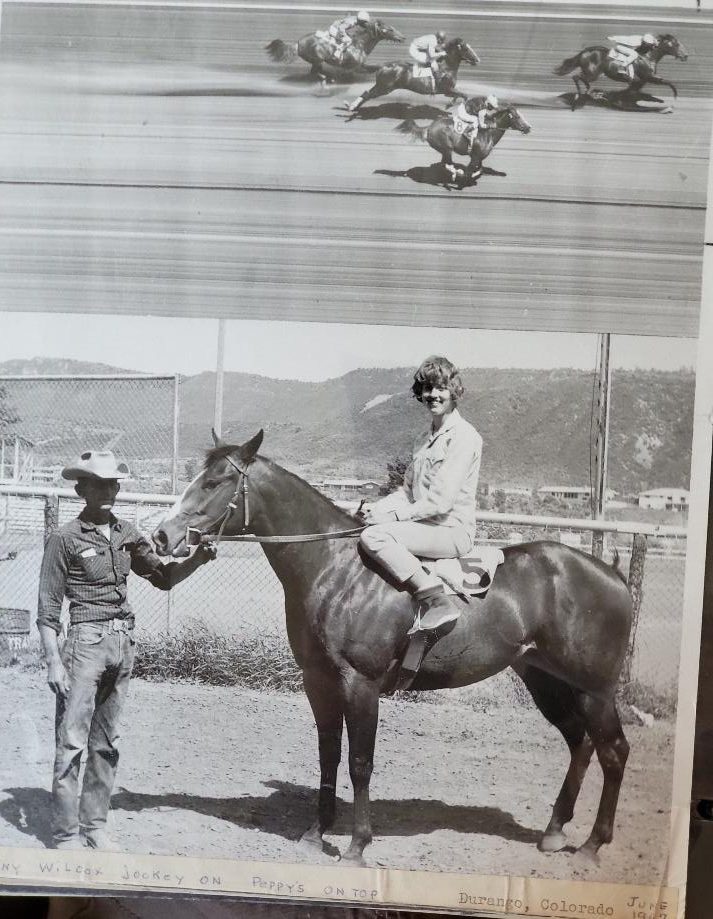
Throughout those years, Dad and I would race through the summer at county fairs and rodeos in Western Colorado and usually Cheyenne Frontier Days in Wyoming. I would ride and we would call those ‘training races’, because they were not ‘recognized by the Quarter Horse Association for “points” from “registered tracks”. Those tracks were open during the winter (when I was in school and girls weren’t allowed to ride in them at that time). So, dad would go or send horses to those tracks with other trainers. He hired Wendell Kenney as his Jockey and continued racing both pintos and quarter horses. He eventually stopped racing Beetlebomb and exclusively used him as a stud horse.
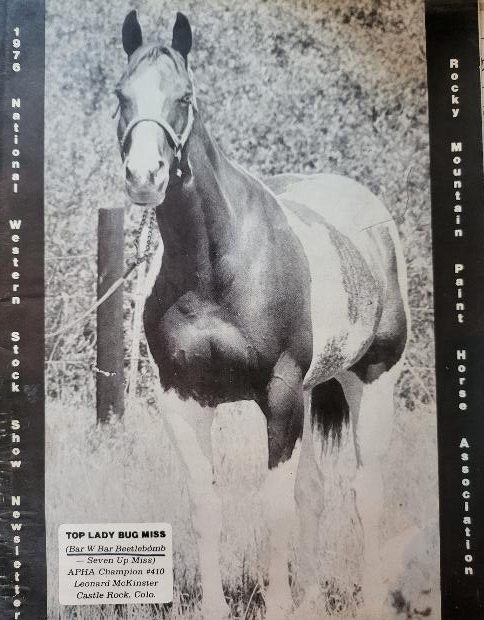
Bar W Bar Beetlebomb (yes, we just called him Beetlebomb for short) sired several offspring.
Cheat sheet of the main horses in our story: (for more detail see the last note on pgs. 26-27)
- On Top – Quarter Horse stallion Dad bought about 1958 (abt. 6 yrs old) Top Deck & Mary Mae
- Candy – Mom’s horse she had before we moved to the ranch
- Paint (registered as a Pinto as Bar W Bar Paint after we bought her)
Now start the Bar W Bar horses:
- Bar W Bar Tops – one of the first, bred from On Top and Candy
- Bar W Bar Beetlebomb – from On Top and Paint
- Bar W Bar Twirp - from Bar W Bar Beetlebomb and
Bar W Bar Buzbomb & Miss Teller Arms
Well-known names from Beetlebomb’s offspring included:
Bar W Bar Buzbomb. My last year at home, in the spring of 1967 the ‘new” Teller Arms shopping center was having a horse competition for “Miss Teller Arms”. Dad thought it would be a great opportunity for Buzbomb, a 2-year-old colt we were just starting to break, to get some experience. We thought it would be a parade. So, in one day this 2-year-old was loaded in the trailer for the first time, came to town and was ridden in a parade with other horses, all kinds of people, kids, noises, etc. Then they announced the ‘competition’ would be each contestant riding the reigning pattern (a very high-skill pattern for well trained horses). We had not even gotten close to training for that. Part of the competition was an interview with the judges first. The judge could see this was a young horse and asked me about our training. I told him we were just starting training, to which he commented he would be interested in how she would do in the reigning pattern. I told him, I too, was interested in that.
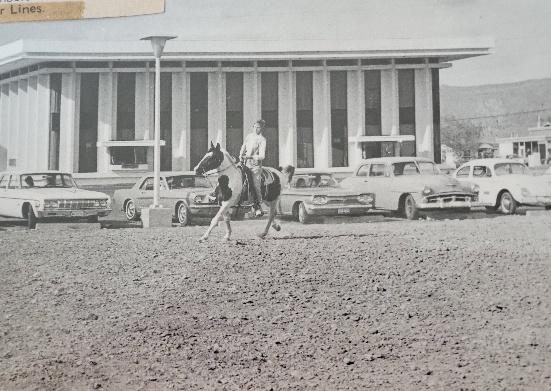
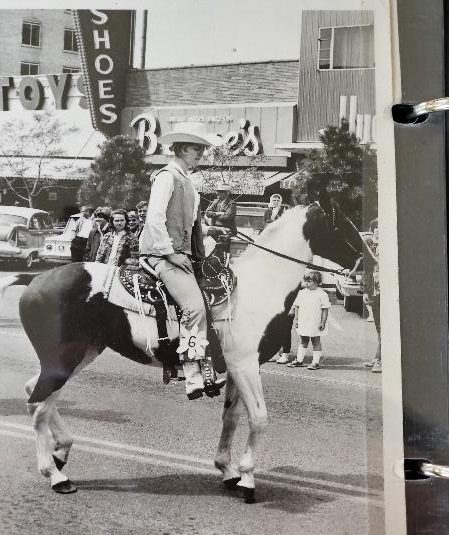
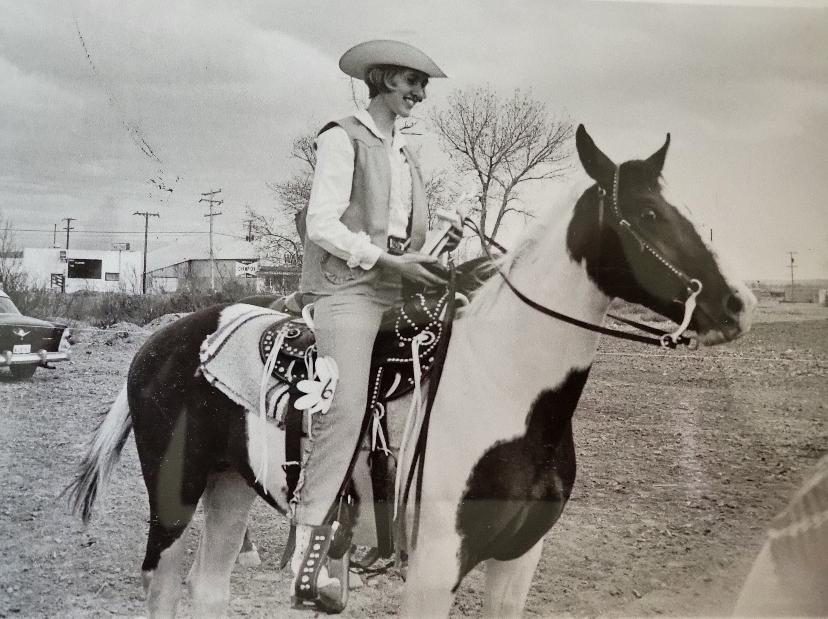
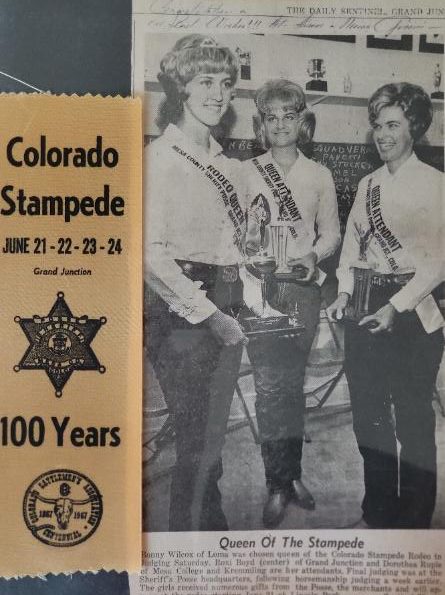
That same spring I also won the Mesa County Sheriff’s Posse Rodeo Queen contest and went on to compete in the Miss Colorado Rodeo competition. All those experiences gave me great opportunities to mature and gain poise I don’t know how I would have otherwise gained.
Part Four
Twirp & the Later Years
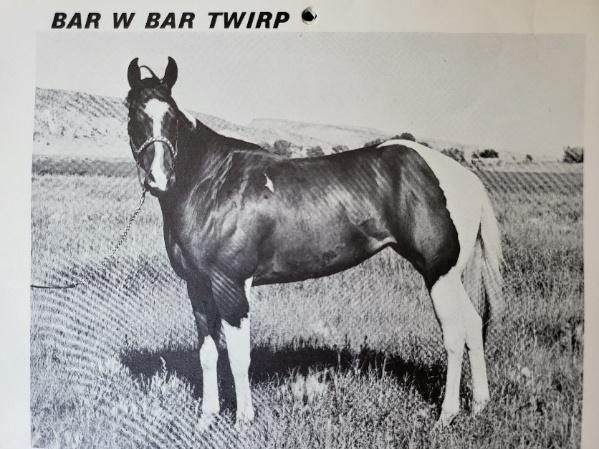
In 1968, after I left home, Bar W Bar Twirp was born. Twirp was my childhood nickname from Dad. Although now that I think of it, perhaps it wasn’t exclusive to me, I was just the last one at home to hear it. Maybe he called the older kids that too. Hmm, I’ll have to ask them. Nope, it was just me.
Twirp was a special horse. Dad raced her and she became the Pinto horse of the year for 1973.
They sold her to a family with a teenage daughter who became very close friends with mom and dad. The Etters and their daughter Bobbi Jo who went on to become Miss Rodeo Colorado on Twirp and competed in the National Contest in Las Vegas. Mom and Dad were huge fans watching Bobbi Jo compete and win.
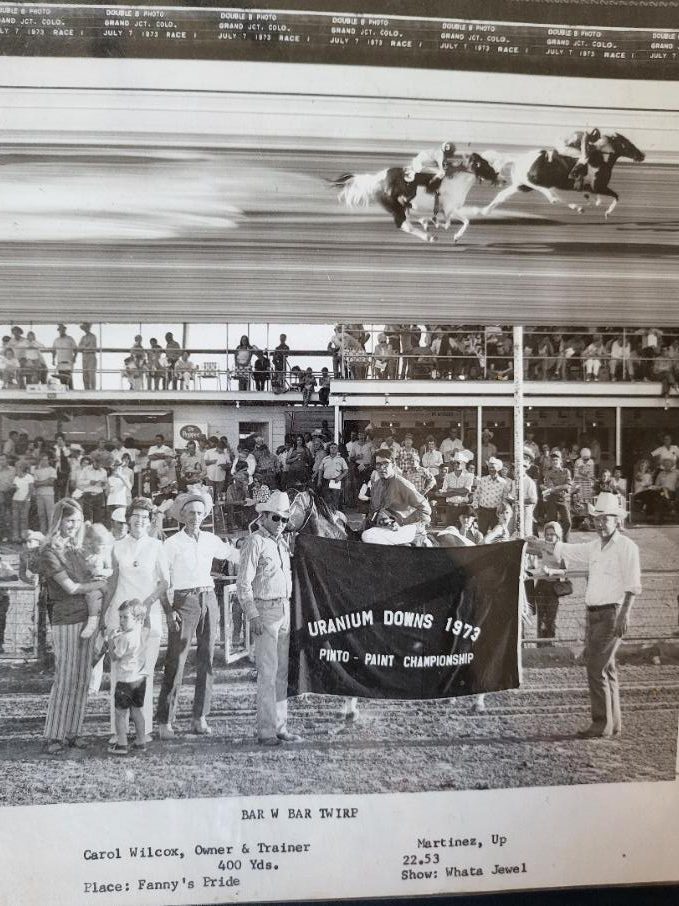
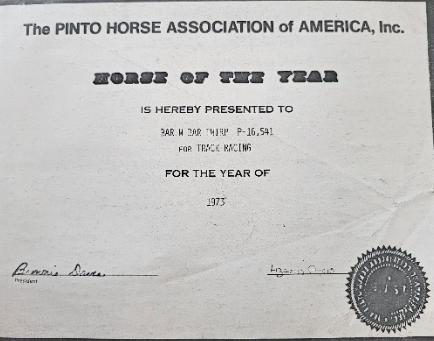
After I moved out of the house and started college, I’ve only been on a horse a few times. I think Betty would agree with me, working with Dad with horses was a wonderful way to grow up. We learned responsibility, self-discipline, to follow through and not quit. Fun was not a way I would describe it. It was work. But it was work with a dad who loved what he was doing, who was honest and a man of integrity. That provided a role model for later life.
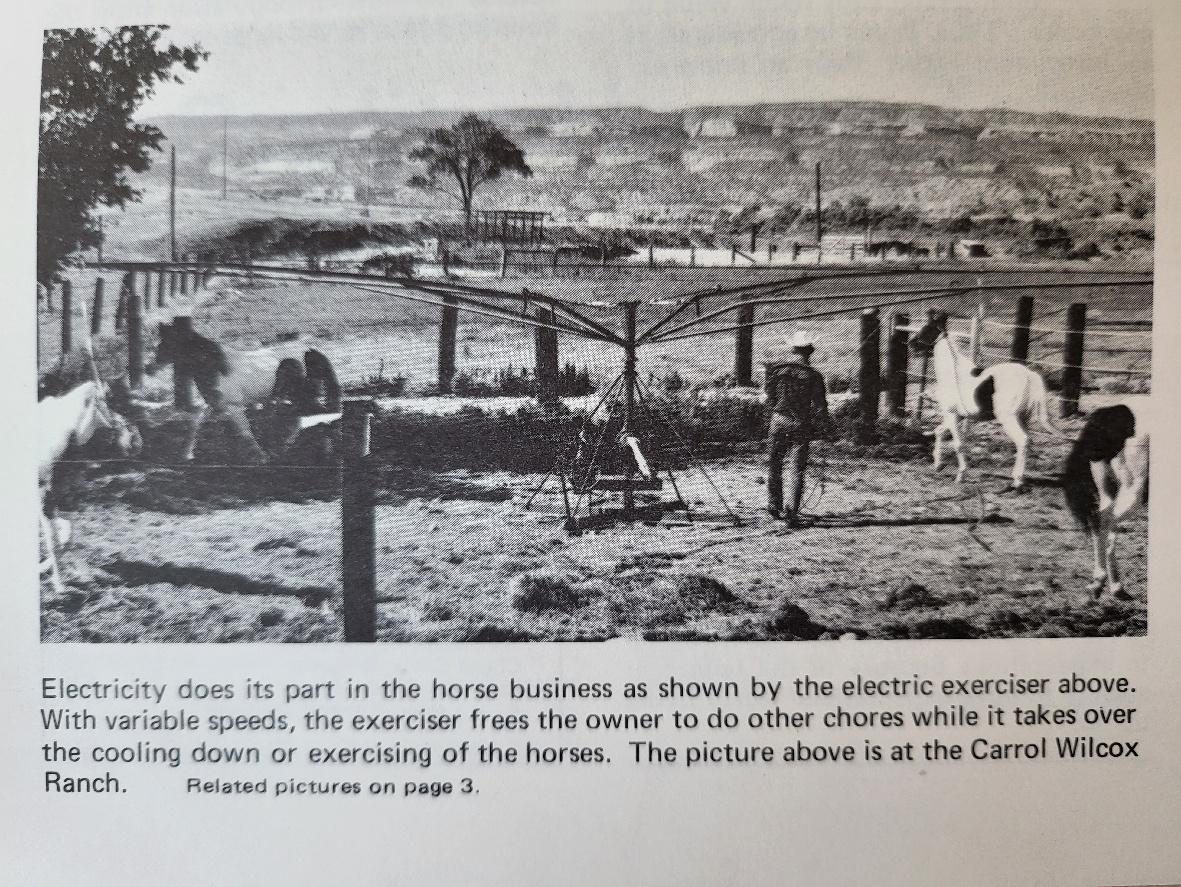
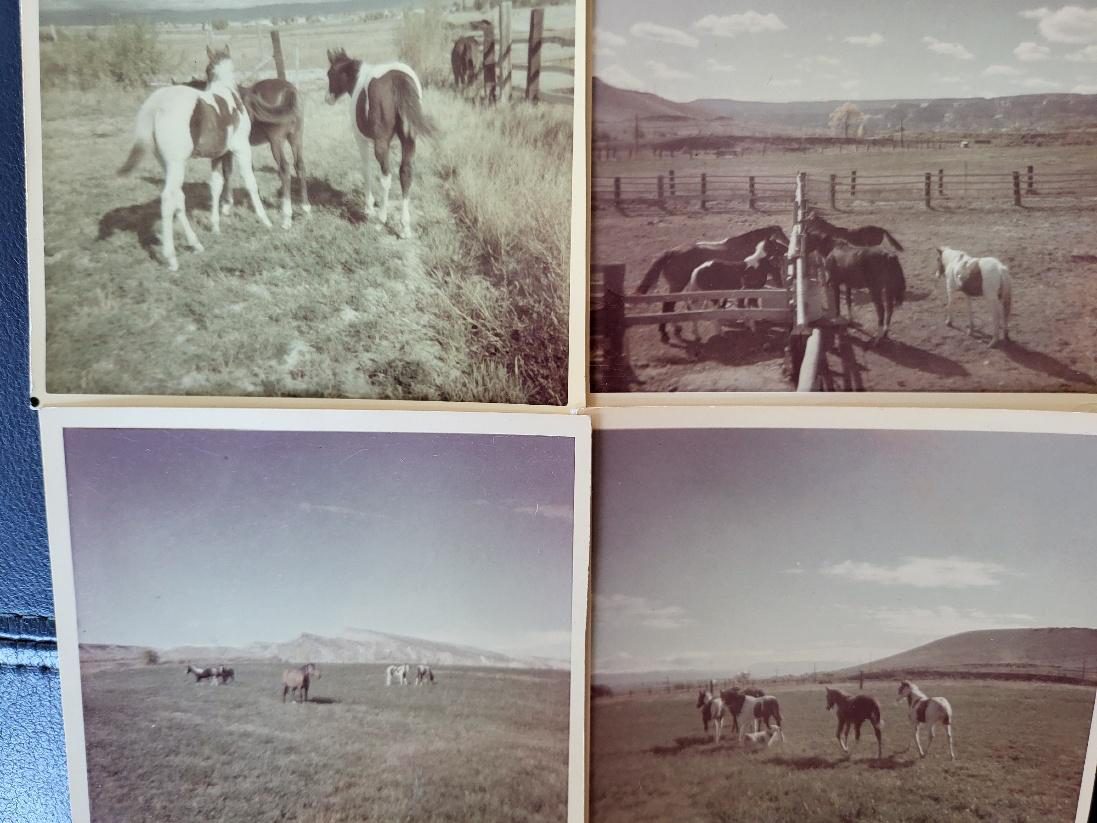
The following pictures are horses Dad continued with. In the mid-1970’s his health deteriorated, and they sold everything at a farm auction. Beetlebomb was leased out to a breeder in Holly, CO. I don’t remember what happened to On Top. I believe he died of old age on the ranch.
Mom and dad bought a motorhome and traveled across the country. As soon as Dad got away from the horses, hay, mold, etc. his breathing improved and they had 12 years of great adventures in the motor home.
Legacy
Well, this trip down memory lane was fun for me and now the story has been told. I am donating my archives to Sue Wilcox, Richard’s daughter-in-law who has carried on the Bar W Bar brand and ranch tradition also at Loma, but not the same place. Betty is donating her archives to her daughter Ronda (Dalley) Martin.
A Last Note — the AI Pond
A last note. Now that we are in the 21st century and I am learning “AI”. I thought the return was delightful, so I include it here for those who haven’t yet put a toe into the AI pond.
Google AI Query: tell me about the horse Bar W Bar Beetlebomb
Bar W Bar Beetlebomb is a registered American Paint Horse foaled in 1962. [1]
Pedigree and Lineage
According to the All Breed Horse Pedigree Database, he has notable roots in classic Quarter Horse racing lines: [1]
- Sire: On Top, a 1954 Quarter Horse sired by the legendary Thoroughbred stallion Top Deck. Top Deck is famous in the equine world for siring many foundational American Quarter Horse Hall of Fame racing and performance horses.
- Dam: Bar W Bar Paint, a 1952 Paint mare.
- Offspring: He sired multiple horses, including a Paint mare named Beetle Britches. [1]
The Pop Culture Connection
While he was a real animal, his unique name is a direct nod to a massive mid-century pop culture phenomenon. "Beetle Bomb" (sometimes spelled Beetlebaum) was the fictional, perennially trailing racehorse in Spike Jones and His City Slickers' wildly popular 1948 comedic rendition of the William Tell Overture. [1, 2]
In the famous comedy routine, a fast-talking track announcer describes a chaotic horse race. While horses with silly names like "Dog Biscuit," "Cabbage," and "Safety Pin" battle for the lead, Beetle Bomb is constantly narrated as being in dead last place by a wider and wider margin—with his name hilariously groaned out in a deep, slow foghorn voice. Against all odds, the race devolves into a boxing match and Beetle Bomb miraculously surges ahead to win at 20-to-1 odds. [1, 2, 3]
The audio track below features the exact comedy routine that inspired the naming of this horse.
Listen to the famous Spike Jones comedy routine that inspired the name "Beetlebomb" https://youtu.be/Kl6bQ6W7f4I?si=4Kj18nSBIg293-wE
some progeny from Bar W Bar Beetlebomb and On Top
Records & Pedigrees
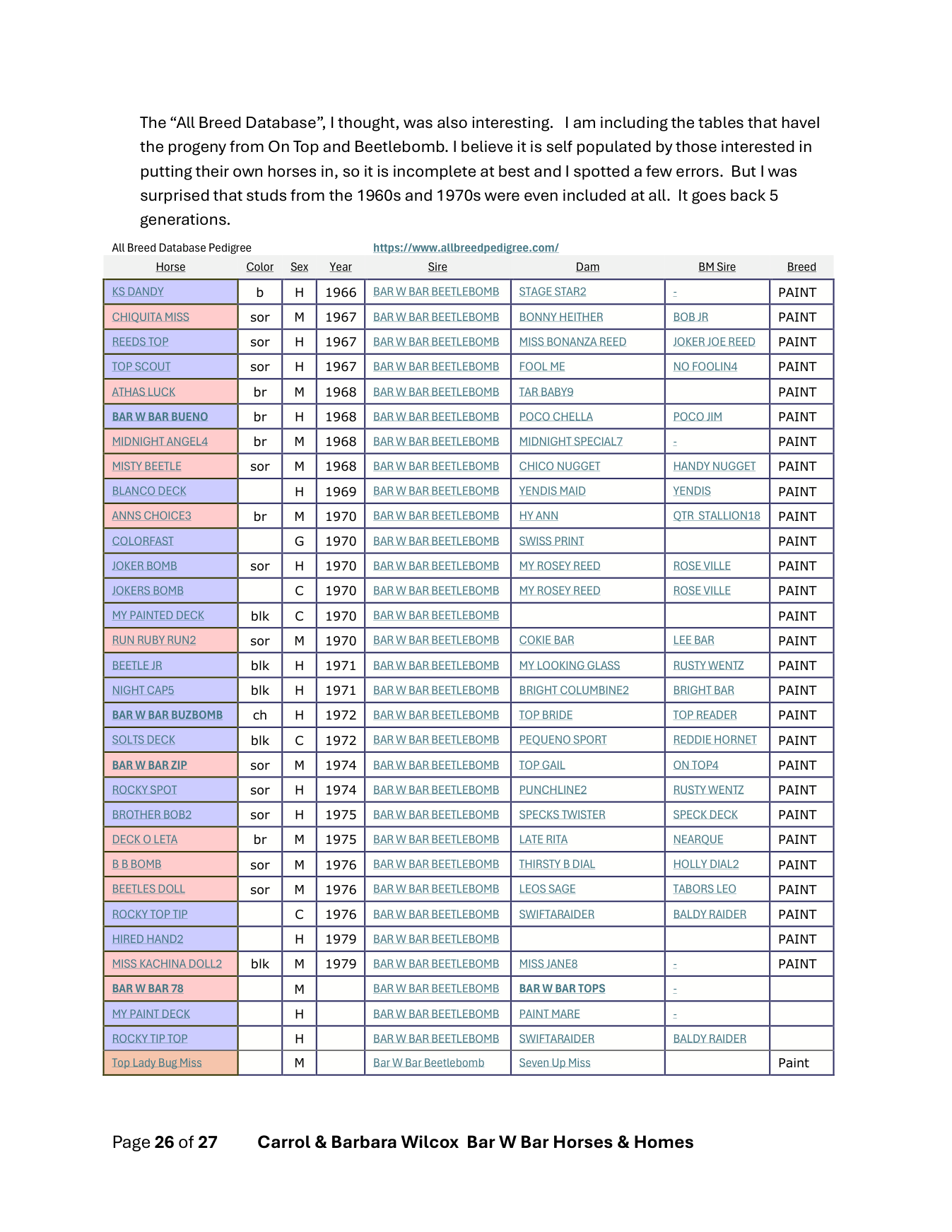
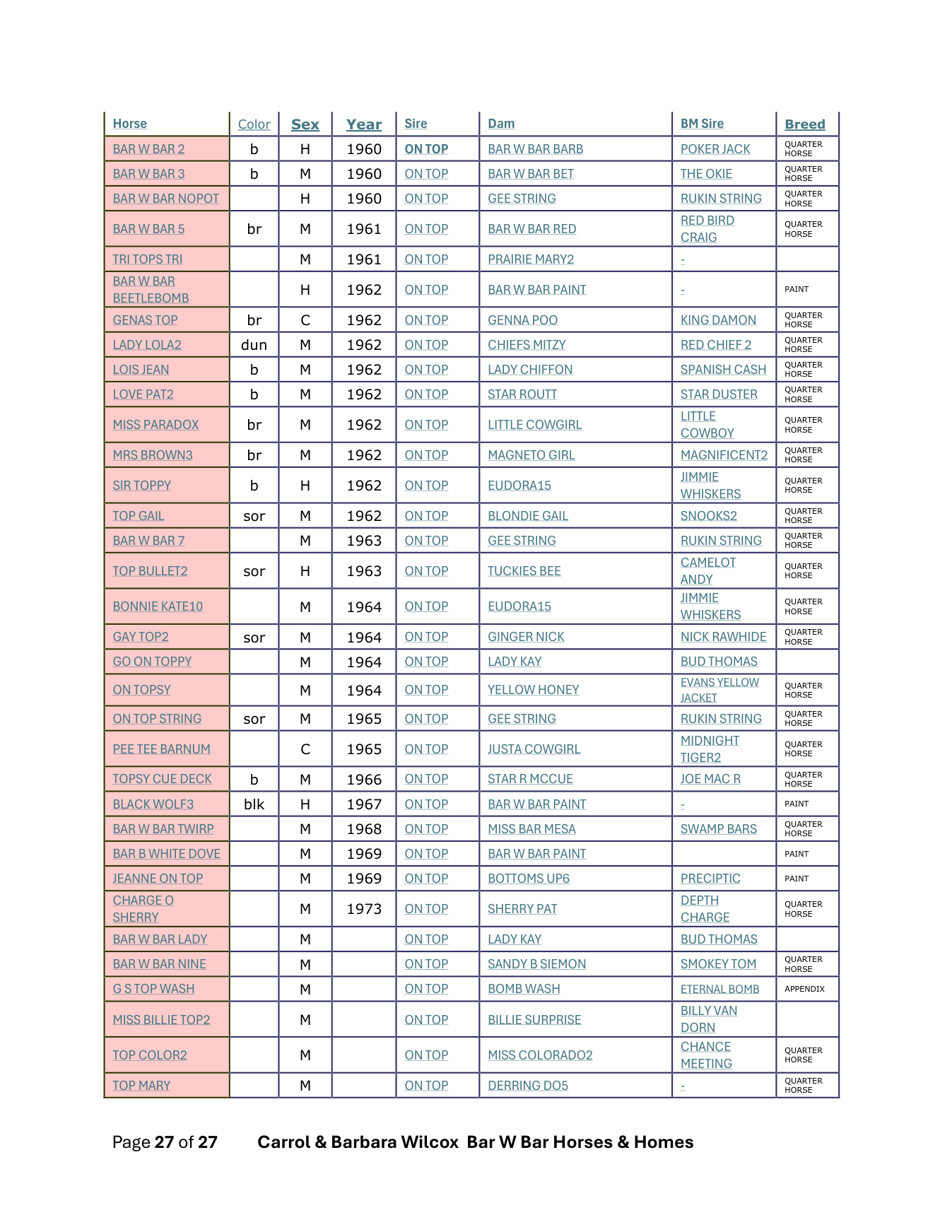
The “All Breed Database”, I thought, was also interesting. I am including the tables that haveI the progeny from On Top and Beetlebomb. I believe it is self populated by those interested in putting their own horses in, so it is incomplete at best and I spotted a few errors. But I was surprised that studs from the 1960s and 1970s were even included at all. It goes back 5 generations.
All Breed Database Pedigree https://www.allbreedpedigree.com/
Offspring of Bar W Bar Beetlebomb — All Breed Database
Offspring of On Top — All Breed Database
Carrol S. and Barbara J. Wilcox · work & travel record from Jun 1941 – early 1944 (WWII)
Work and Travel Record, 1941–1944
Carrol S. and Barbara J. Wilcox work & travel record from Jun 1941 – early 1944 (WWII)
1941
Mar 17, 1941 Ron S. Wilcox, born in Grand Junction, CO
Jun 27-29 he made $30 in Ohio. (Richard would have been not quite 3 yrs & Ron 3months). Either he was working 2 jobs with overlapping time periods for a few weeks, or mom has the early dates wrong in late May/June.
Jul 7 – Oct 23, He was carpenter 1408 at Hunkin-Conkey Construction on the Ravenna Arsenal Project near Akron Ohio. He earned anywhere from $55 to a high of $83 per wk (avg $70).
https://www.kentohio.net/kent-history/ravenna-arsenal-had-explosive-effect-on-the-county
I found a few interesting items about that company and arsenal at that time. Unfortunately, I can’t pull up the whole Congressional Review notes about the testimony about unions, wages, etc. in 1941 at that plant. Perhaps that’s why he left….
The next work listed after that was:
Dec 2-28 as a carpenter in Texarkana, (Lone Star Ordnance (Army Ammunition Plant), Hooks, Texas) making abt $45 a wk for those 4 wks.
1942
Jan – Feb they were still in Texarkana making an avg of $60/ wk
Interesting: https://www.tshaonline.org/handbook/online/articles/dml01
http://www.texasescapes.com/EastTexasTowns/Hooks-Texas.htm
This site is also listed as an ‘official’ Asbestos Site by a law firm soliciting prev. employees… HA!
Mar – Apr Las Vegas making abt. $65 (wide variation $34-$96)
Apr 17, ($15), Apr 24 ($26) Colorado Springs
May 2-Nov 11: Marion Ohio avg. $63/wk
Nov 18-Jan 21, 1943 Dayton, Ohio avg. abt. $58 (again wide variation $42-$84)
1943
Jan 26 – Mar 23 Vandalia, Ohio (10 miles north of Dayton OH) 6.5 miles from Phoneton, OH) He worked for Marshbank, I can’t find out anything about them.
Feb 13, 1943 Betty J. Wilcox born in “Troy” Ohio. Troy is the county seat and may be where the birth is registered (It is on the birth certificate), not necessarily the town where they were living. Richard believes they were living in Phoneton, Ohio when Betty was born. (very near Troy, in the same county both north of Dayton, OH).
Mar 31 – Oct 13 it is unclear where they are, but working for 3 different people/companies (Johnson, Blair,…?) making more $$, (avg abt. $80’s/wk huge variation $57-$144 wk)
Dec back in Marion, OH only $88 for the month
1944
Jan 3-19 back at Hunkin-Conkey carpenter #944. Ravenna Arsenal, near Akron OH Abt $90/wk , but only 3 wks…. That is the END of the record
THEY MUST HAVE HEADED BACK TO GRAND JUNCTION, IF THEY WERE HOME April 1945 when FDR died… This is the time line I can make out from the hand written Social Security records.